
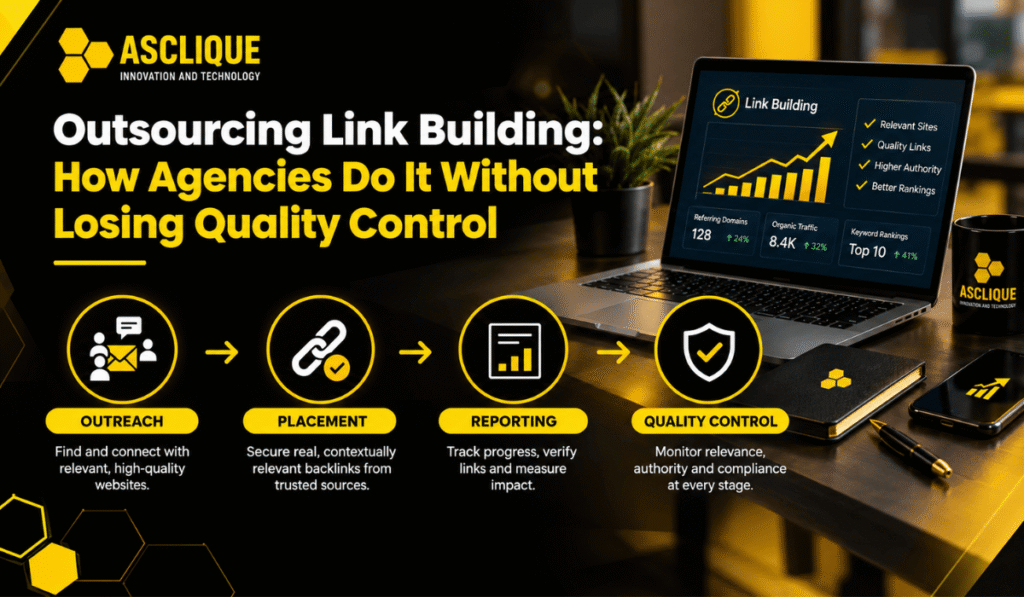
Link building is one of the most time-intensive services in SEO. Finding prospects, writing pitches, managing relationships, placing content, and tracking results demands dedicated personnel and consistent effort. Many agencies — and in-house SEO teams — reach a point where the volume of link building required exceeds what their team can reliably handle.
Outsourcing link building is a practical solution, but it carries real quality risks. This guide explains how it works, what to look for in a provider, and how to maintain quality control when someone outside your team is building links for your clients.
Why Agencies Outsource Link Building
The main reasons agencies outsource backlink acquisition:
Scale. A single link builder can typically acquire 10–20 links per month with high-touch outreach. Agencies with 20+ clients need far more capacity than an in-house team can usually provide at a sustainable cost.
Specialization. Specialist link building agencies have established relationships with publishers, refined outreach systems, and content teams that make link placement more efficient than generalist agency staff can achieve alongside other duties.
Cost. Hiring full-time link builders in-house — plus the tools, systems, and management overhead — often costs more than outsourcing to a white label provider at equivalent quality.
Focus. Outsourcing fulfillment frees agency account managers to focus on strategy, client communication, and growth, rather than tactical outreach.
Types of Link Building You Can Outsource
Not all link building is the same. The method affects quality, risk, and price:
Guest posting. Content is written and placed on third-party websites with a link back to the client’s domain. The quality of the publication, the editorial standards of the site, and the relevance of the niche matter enormously. Bulk guest posting on low-quality networks is a significant risk.
Digital PR. Content assets — original research, data studies, expert commentary — are pitched to journalists and publications. Links earned this way are typically more authoritative and editorially placed. This is harder to scale than guest posting but produces stronger results.
Niche edits / link insertions. A link is placed within existing content on a third-party website. This can be legitimate (replacing a broken link with a relevant resource) or paid. Google’s guidelines prohibit paying for links, and the risk is in distinguishing legitimate niche edits from paid link schemes.
Broken link building. Agencies identify broken links on relevant websites and offer replacement content. The link earned is editorial. This is time-intensive and harder to outsource reliably.
Resource page link building. Pages that list resources in a niche are a natural fit for link placement. Identifying and pitching these pages can be outsourced.
What to Look for in a White Label Link Building Provider
Quality varies widely. Providers with low prices often use low-quality link networks that provide short-term DR gains but long-term risk.
Evaluate these factors:
Transparency about placement. A reputable provider will show you the sites where links are placed before you commit and will share the target domains in advance for approval. Providers who won’t share placement sites are a warning sign.
Content quality. Guest posts and content placements should be genuinely useful articles — not thin, AI-generated, or keyword-stuffed content that exists purely to host a link. Low-quality content placed on real sites is accepted by some editors but carries increasing risk as Google’s spam policies evolve.
Publisher website quality. Evaluate target sites for real traffic (use Ahrefs or Semrush to check), genuine content, organic visitors, and relevance to your client’s niche. Links from sites with no real traffic or audience provide minimal SEO value.
Relevance. A link from an irrelevant site contributes less than a link from a site in the same or adjacent niche. Some link building providers prioritize DR over relevance — this is the wrong priority.
Reporting. You should receive a full link report with anchor text, placement URL, DR of the linking domain, and live link confirmation for every link placed.
Turnaround time. Genuine editorial outreach takes time. Providers promising 20+ links within two weeks are almost certainly working from link networks rather than real editorial placements.
Red Flags to Avoid
- Providers who guarantee a specific number of links with a specific DR at suspiciously low prices
- No option to review target sites before placement
- All links come from the same set of websites across multiple clients (link farms)
- Guest post content that is clearly AI-generated, generic, or thin
- Anchor text that is overly keyword-rich or unnatural
- No contact information, no case studies, no verifiable client references
How to Maintain Quality Control When Outsourcing
Vet every site before approval. Build a review step into your process where you or a team member reviews proposed placement sites before they are confirmed. Check for real traffic, real content, and niche relevance.
Audit links placed quarterly. Use Ahrefs or a similar tool to review links delivered and confirm they remain live and indexed. Some providers place links on low-quality sites that get deindexed, removing the SEO value.
Set anchor text guidelines. Branded and natural anchors (company name, bare URL, topic description) should make up the majority of a healthy link profile. Avoid heavy use of exact-match commercial keywords as anchor text.
Start with a small test order. Before committing to a long-term contract, commission a small batch of links — five to ten — and evaluate the quality, communication, and delivery before scaling.
Track domain diversity. A healthy link profile draws from many different referring domains. If a provider keeps placing links from the same set of sites, the incremental value diminishes and the pattern may attract scrutiny.
Pricing: What Does Outsourced Link Building Cost?
Pricing for white label link building depends on the type of link, the DR of the target site, and the provider’s model:
| Link Type | Typical Price Range |
|---|---|
| Guest post (DR 20–40) | $100–$300 per link |
| Guest post (DR 40–60) | $250–$600 per link |
| Guest post (DR 60+) | $500–$1,500+ per link |
| Digital PR earned link | Variable; typically project-priced |
| Niche edit (DR 30–50) | $150–$400 per link |
Agency markup on white label link building typically ranges from 30–100% depending on the agency’s positioning and client contract terms.
Frequently Asked Questions
Is outsourcing link building safe for clients?
It depends entirely on the quality of the provider and the links placed. Outsourcing to a reputable white label link builder that places editorial links on real sites is safe. Using cheap bulk link schemes puts clients at risk of Google penalties.
How many links does a website need per month?
This varies by industry competitiveness, current backlink profile, and target rankings. Most small to mid-size business SEO campaigns benefit from 5–20 high-quality links per month rather than large volumes of low-quality links.
What is a white label link building service?
A white label link building service delivers links under your agency’s branding. The client does not know which provider fulfilled the links. Reports, communication, and any materials can be rebranded as your agency’s work.
Should I outsource all link building or keep some in-house?
Many agencies outsource the volume work (guest posting, niche edits) while keeping high-value activities like digital PR and brand partnerships in-house. A hybrid model often produces the best balance of quality and scale.
Asclique provides link building services for businesses and agencies. For agencies looking to scale their link building delivery, we also offer white label arrangements — see our white label SEO services for more information.