
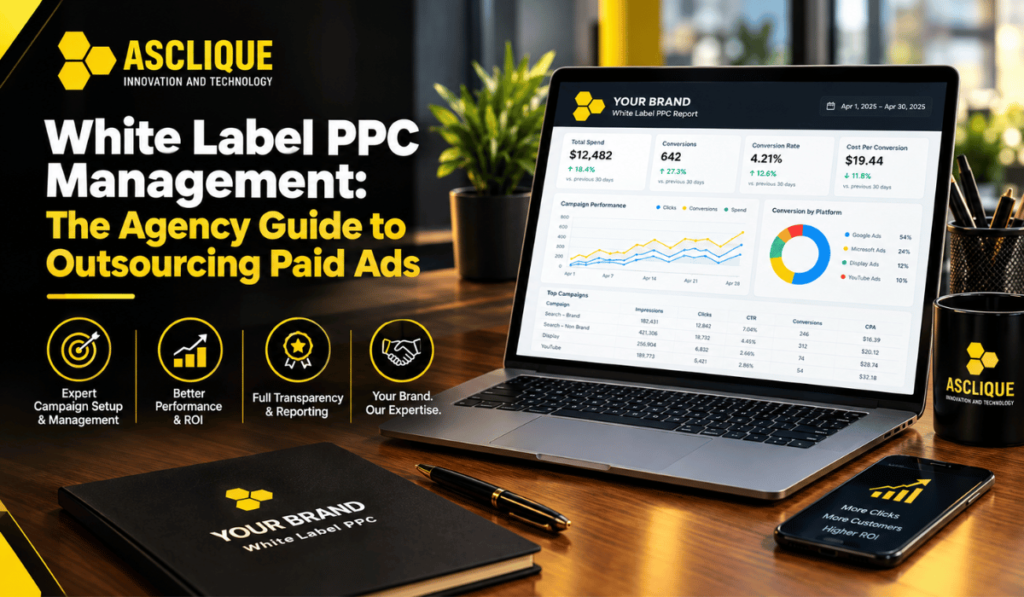
Many digital marketing agencies offer PPC services to clients without managing campaigns internally. Instead, they partner with a white label PPC provider that handles campaign setup, management, and optimization, while the agency maintains the client relationship and delivers reports under its own branding.
This model lets agencies add paid search and paid social to their service offering without hiring dedicated PPC specialists or building the internal infrastructure to manage campaigns at scale.
What Is White Label PPC Management?
White label PPC management is a service arrangement where an agency outsources paid advertising work — Google Ads, Meta Ads, LinkedIn Ads, and similar platforms — to a third-party provider that fulfills the work without client-facing visibility. The client interacts only with the agency. All reports, strategy documents, and communications go out under the agency’s brand.
The white label provider acts as an invisible delivery team. From the client’s perspective, the agency is running their paid campaigns directly.
Who Uses White Label PPC Services?
White label PPC is most commonly used by:
- SEO agencies that want to add paid advertising to their offerings without building an internal PPC team
- Web design and development agencies that field client requests for advertising alongside site builds
- Full-service marketing agencies that have PPC clients but insufficient internal capacity for additional accounts
- Freelancers and small agencies that win a PPC client but lack the in-house expertise for specific platforms
What Is Typically Included
Standard white label PPC packages usually cover:
- Campaign strategy and initial account setup (keyword targeting, audience segmentation, bidding strategy, campaign structure)
- Ad copy creation and testing
- Landing page recommendations
- Ongoing bid management and optimization
- Conversion tracking setup (or verification)
- A/B testing of ad variations
- Negative keyword management
- Branded monthly performance reports delivered to the agency
- Regular optimization notes and account commentary
Higher-tier arrangements may include dedicated account managers, proactive strategy sessions, and channel expansion (adding platforms as campaigns mature).
Pricing Models for White Label PPC
White label PPC providers typically price in one of three ways:
| Pricing Model | How It Works | Best For |
|---|---|---|
| Percentage of ad spend | Provider charges 10–20% of monthly ad spend | Larger clients with high ad budgets |
| Flat monthly fee | Fixed price per account regardless of spend | Predictable margins; smaller client budgets |
| Tiered by spend bracket | Price increases as ad spend crosses thresholds | Scaling accounts |
Agencies then mark up the provider’s fee when billing the client. A typical markup is 30–100% depending on the agency’s positioning and what the market bears. Agencies often charge clients a percentage of ad spend (typically 15–20%) and pay the white label provider a lower rate, keeping the difference as margin.
How to Choose a White Label PPC Provider
Key factors to evaluate:
Platform expertise. Confirm the provider has certified and experienced specialists for the platforms your clients use. Google Ads and Meta Ads are most common, but clients may also need LinkedIn, Microsoft Ads, or programmatic channels.
Transparency about who manages the account. Some providers rotate accounts across junior staff. Ask whether your accounts have a dedicated or primary manager, and what qualifications they hold.
Communication. You will depend on this provider to deliver work that reflects on your agency. Communication speed, proactiveness, and responsiveness during problems are critical.
Reporting quality. White label reports should be properly branded, easy to interpret, and focused on business outcomes — not just platform metrics. Review a sample report before committing.
Account ownership. Confirm that your agency (and ultimately your client) retains ownership of all ad accounts. Some providers set up accounts in their own systems, creating dependency and making it difficult to transition to a different provider or in-house management.
Results. Ask for case studies, references, or performance data from comparable client accounts. Any provider unwilling to show evidence of results is a risk.
Common Risks to Manage
Loss of client trust if quality falls. Because the client associates the PPC performance with your agency, poor results from a white label provider damage your relationship directly. Ongoing monitoring of key metrics — cost per acquisition, conversion rate, return on ad spend — is essential even when outsourced.
Margin compression. If ad spend is low and the provider’s fee is high relative to what you can charge the client, white label PPC may not be profitable. Model the economics carefully before committing.
Contract lock-in. Some providers require long contracts. If performance is poor, being locked in creates difficult conversations with clients. Prefer providers offering monthly or quarterly arrangements, especially initially.
Over-promising to clients. Be realistic with clients about timelines. PPC campaigns typically require 60–90 days of optimization before performance stabilizes. Agencies that oversell immediate results face problems regardless of who manages the campaigns.
White Label PPC vs. Hiring In-House
| Factor | White Label | In-House |
|---|---|---|
| Upfront cost | Low | High (salary, benefits, tools) |
| Ramp-up time | Fast (days to weeks) | Slow (hiring, onboarding, training) |
| Platform breadth | High (provider covers multiple platforms) | Limited to who you hire |
| Quality control | Depends on provider | Direct |
| Margin at scale | Compresses as volume grows | Improves as team utilization increases |
| Client relationship | Agency maintains full ownership | Direct |
For agencies under 10–15 PPC clients, white label is usually more cost-effective. As volume grows, the economics of in-house management improve, and many agencies bring PPC in-house at scale while using white label for overflow or specialist platforms.
Frequently Asked Questions
Do clients know their PPC campaigns are managed by a third party?
Only if you tell them. White label arrangements are confidential. All client-facing materials use your agency’s branding, and the provider does not communicate with clients directly.
What platforms do white label PPC providers cover?
Most established providers cover Google Ads and Meta Ads as standard. Coverage of LinkedIn Ads, Microsoft Ads, Pinterest Ads, and programmatic display varies by provider. Confirm coverage before signing.
How much should I charge clients for white label PPC management?
Common agency pricing is 15–20% of monthly ad spend, with a minimum management fee (often $500–$1,500/month) for smaller budgets. Model your markup against the provider’s fee to confirm the arrangement is profitable.
What is the minimum ad spend for white label PPC to be viable?
Most white label PPC providers work with clients spending $1,500–$2,000/month minimum on ads, though some accept lower budgets. Below a certain spend level, there is not enough data for meaningful optimization.
Asclique provides digital marketing services including paid advertising alongside our core SEO services. For agencies looking to scale their paid media offering, get in touch to discuss white label options.