
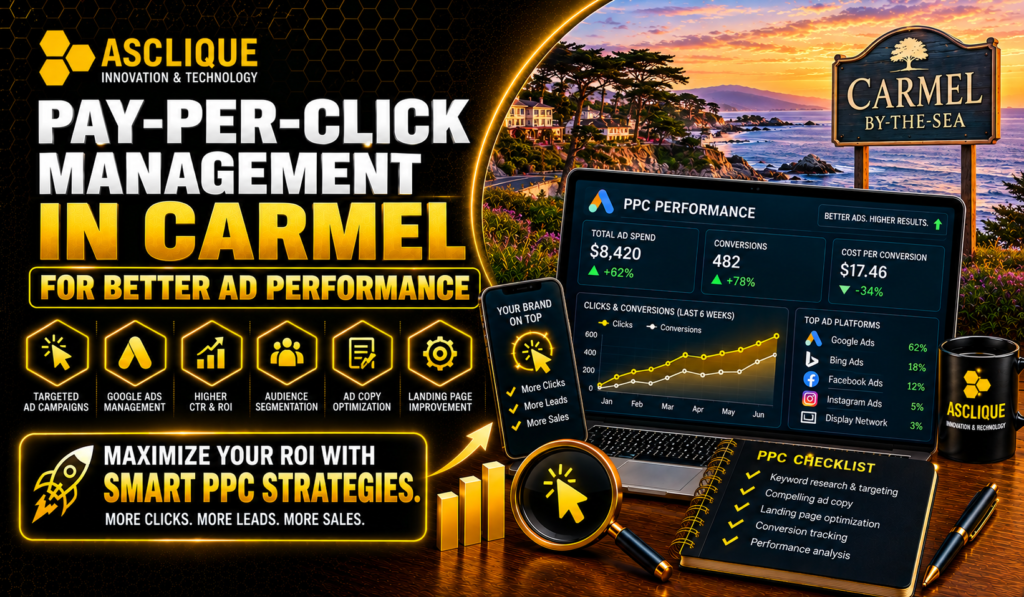
Carmel has grown into one of the most competitive small-business markets in the Indianapolis metro area. With a thriving mix of retail centers, medical practices, home service providers, and professional firms clustered around the Arts & Design District and City Center, local companies increasingly compete not just for foot traffic, but for visibility on Google. Pay-per-click (PPC) advertising has become one of the fastest ways to capture that visibility,but only when it is managed with discipline, strategy, and continuous optimization. A poorly managed campaign can drain a marketing budget in weeks; a well-managed one can become the single most reliable source of qualified leads a business has.
This article breaks down what effective PPC management actually involves, why Carmel businesses in particular benefit from a localized approach, and how partnering with an experienced digital marketing team can turn ad spend into measurable revenue.
Why PPC Matters for Carmel Businesses
Search engine optimization builds long-term visibility, but it takes months to show results. PPC, by contrast, places a business at the top of search results almost immediately. For a Carmel-based HVAC contractor, dental office, or boutique retailer, that speed matters,especially when a competitor two blocks away is already running ads for the same keywords.
The core appeal of PPC is its efficiency: advertisers only pay when a user actually clicks the ad, meaning the budget is spent on people who have already shown interest rather than on passive impressions. Combined with precise geographic targeting, a business can restrict its ads to Carmel and the surrounding Hamilton County area, ensuring the budget reaches people who are genuinely in a position to become customers rather than being spread thin across an entire state or country.
The Core Components of Professional PPC Management
Running a PPC campaign is far more involved than simply setting a budget and choosing a few keywords. Professional management typically covers several interconnected disciplines, each of which affects overall performance.
Keyword Research and Selection
Every successful campaign starts with identifying the search terms that real customers are actually using. This involves analyzing search volume, competition level, and commercial intent to prioritize keywords that are likely to convert rather than simply generate clicks. For a local business, this also means layering in geo-specific and long-tail variations, phrases a Carmel resident might type when they are close to making a purchase decision.
Ad Copywriting
The text of an ad determines whether a searcher clicks through or scrolls past. Strong ad copy is concise, speaks directly to the searcher’s need, and includes a clear call to action. Testing different headlines and descriptions against one another is standard practice, since even small wording changes can shift click-through rates significantly.
Landing Page Alignment
An ad is only as effective as the page it sends visitors to. If the landing page doesn’t match the promise made in the ad, or if it loads slowly or is difficult to navigate on mobile, the click is wasted. Managing a campaign properly means continuously refining landing pages so that the message, design, and conversion path all reinforce one another.
Competitor and Market Analysis
Understanding what competitors are bidding on, how they position their offers, and where gaps exist in the local market allows a campaign to be built with a clear point of differentiation rather than guesswork.
Bid Management and Budget Control
Bids need to be adjusted regularly based on performance data, increasing spend on keywords that convert well and reducing or pausing those that underperform. This is an ongoing process, not a one-time setup, since search behavior, competition, and seasonality all shift over time.
Testing and Continuous Optimization
A/B testing different ad variations, landing pages, and audience segments is what separates a campaign that plateaus from one that keeps improving. Regular testing surfaces the combinations that actually move the needle on conversions and cost per acquisition.
Tracking, Reporting, and Analytics
None of the above matters without accurate measurement. Ongoing management includes monitoring click-through rates, conversion rates, cost per click, and return on ad spend, then using that data to guide every subsequent decision.
Types of PPC Campaigns Worth Considering
Search ads remain the backbone of most local campaigns, placing a business directly in front of people actively searching for its products or services. But a well-rounded strategy often layers in additional formats: display ads for cost-effective brand visibility, shopping ads for retailers wanting to showcase specific products with pricing and imagery, video ads for businesses with strong visual content, and remarketing ads that re-engage visitors who browsed a site but didn’t convert the first time. Choosing the right mix depends on the business model, the sales cycle, and the available budget, which is where experienced guidance becomes valuable.
Why Local Businesses Choose to Outsource PPC Management
Many Carmel business owners initially attempt to manage their own Google Ads accounts, only to find that the platform’s complexity outpaces the time they can realistically dedicate to it. Between keyword research, bid adjustments, ad testing, and reporting, a campaign requires consistent, hands-on attention to perform well. This is where a specialized digital marketing partner adds real value.
One such resource is Asclique Innovation & Technology, a digital marketing agency that offers dedicated pay-per-click management as part of a broader suite of services. According to the agency, its approach centers on treating PPC as a continuous, data-driven process rather than a one-time setup,covering keyword selection, ad creation, competitor research, A/B testing, and ongoing campaign tracking so that businesses can focus on operations while the advertising side is actively optimized.
Asclique’s PPC offering also spans multiple ad formats, including search ads for immediate search-result visibility, display ads for budget-conscious brand exposure, shopping ads suited to e-commerce and product-based businesses, video ads for businesses with visual content to showcase, and remarketing ads designed to bring back visitors who didn’t convert on their first visit. This range allows a campaign to be tailored to the specific goals of a business rather than relying on a single ad type for every situation.
Beyond PPC, the agency describes a broader digital marketing capability that includes search engine optimization, local SEO, social media marketing, content marketing, and link building,services that can complement a paid advertising strategy so that a business is building both immediate visibility through ads and longer-term organic presence at the same time. For Carmel businesses evaluating a marketing partner, this kind of integrated approach can be worth exploring, particularly for owners who want their PPC campaigns supported by a wider strategy rather than run in isolation.
Measuring What Success Looks Like
A well-managed PPC campaign should produce more than clicks, it should produce a measurable return. Key indicators worth tracking on an ongoing basis include cost per click, click-through rate, conversion rate, cost per acquisition, and overall return on ad spend. Businesses should expect regular reporting that ties these numbers back to actual leads, calls, or sales, rather than vanity metrics that look impressive but don’t reflect real business impact.
Final Thoughts
For Carmel businesses competing in a crowded local market, pay-per-click advertising offers one of the fastest paths to qualified traffic and new customers, but only when it’s managed with the same rigor as any other core business function. Keyword strategy, ad copy, landing pages, bidding, and analytics all need to work together, and they need continuous refinement rather than a “set it and forget it” mindset. Whether a business chooses to manage campaigns in-house or work with a dedicated agency, the businesses that see the strongest returns are consistently the ones treating PPC as an evolving strategy rather than a static ad buy.
FAQs
What is pay-per-click management?
Pay-per-click management involves planning, launching, monitoring, and optimizing paid advertising campaigns. It includes keyword research, ad copywriting, bid management, landing page optimization, conversion tracking, and performance analysis.
Why is PPC important for businesses in Carmel?
PPC helps Carmel businesses reach potential customers who are actively searching for their products or services. With geographic targeting, businesses can focus advertising budgets on customers in Carmel and nearby areas.
How much does PPC management cost in Carmel?
The cost varies depending on the business industry, campaign goals, competition, keywords, and advertising budget. A professional PPC strategy should be customized according to the business’s goals and expected return on investment.
What types of PPC campaigns can Carmel businesses use?
Businesses can use search ads, display ads, shopping ads, video ads, and remarketing campaigns. The right combination depends on the business model, target audience, sales cycle, and marketing objectives.
How does PPC management improve ad performance?
Professional PPC management continuously analyzes campaign data and optimizes keywords, bids, ad copy, audiences, and landing pages. This can help reduce wasted ad spend while improving conversions and overall campaign efficiency.
How do you measure PPC campaign success?
Important PPC metrics include click-through rate, cost per click, conversion rate, cost per acquisition, and return on ad spend. Connecting these metrics to actual leads, calls, and sales provides a clearer picture of campaign performance.