
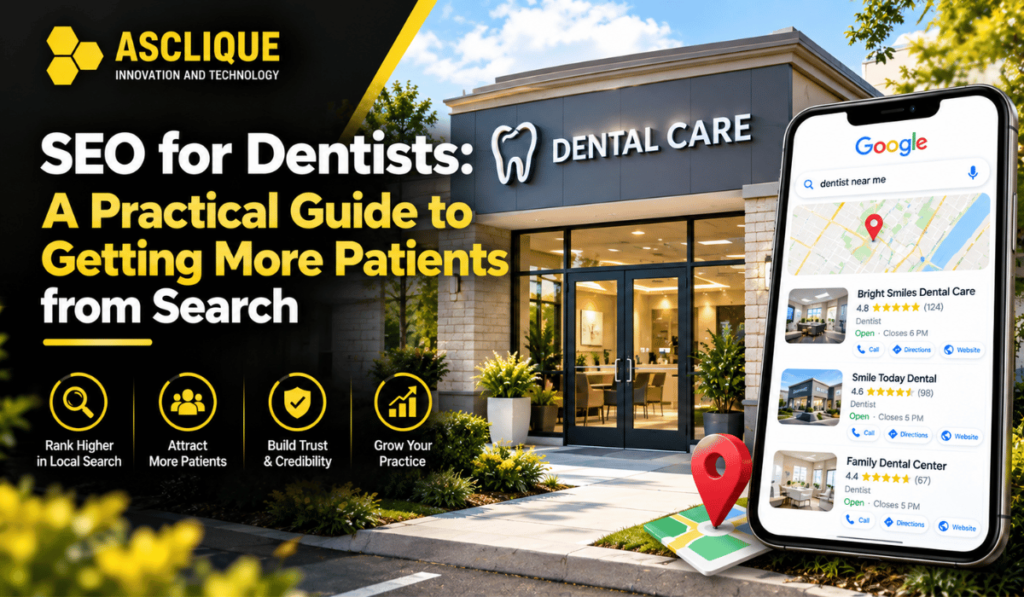
New patients search for dental practices online before calling. Whether they need a general dentist, an emergency appointment, or a specific procedure like Invisalign or implants, Google is their first stop. For dental practices, ranking in those local searches directly affects how many new patient inquiries come through.
This guide covers the local SEO fundamentals every dental practice needs, along with service-specific keyword strategies and the content approach that builds long-term visibility.
Why SEO Matters for Dental Practices
Dental services are local, high-value, and often needed urgently. A patient searching “emergency dentist [city]” or “dentist accepting new patients near me” is ready to book. Unlike many other types of purchase research, dental searches have high conversion intent — people find a dentist and call.
Paid advertising works for dental practices but carries ongoing cost. Organic SEO, once established, generates consistent leads at a lower cost per acquisition over time, making it one of the highest-ROI marketing channels for growing practices.
Google Business Profile for Dental Practices
Your Google Business Profile (GBP) is the highest-leverage starting point. It determines how your practice appears in Google Maps and in the local three-pack results shown at the top of local searches.
Optimize your GBP:
- Set your primary category to “Dentist”
- Add relevant secondary categories: “Cosmetic Dentist,” “Orthodontist,” “Pediatric Dentist,” “Emergency Dental Service” — only those that apply to your practice
- Write a specific, informative description that mentions your location, main services, and what makes your practice worth choosing
- Upload photos: your exterior (so patients can find you), reception area, treatment rooms, and team photos
- Keep hours updated, including holiday hours
- Set your service list to include all procedures you offer
- Enable online booking if your practice management software supports it
- Enable Google Messages for quick-response communication
Reviews are essential. The number of reviews, their recency, and your rating all affect local rankings. Practices with more consistent review volume outrank competitors even when proximity is similar. Build a review request into your checkout process — most patients are willing to review if asked immediately after a positive visit.
Keyword Strategy for Dental Practices
Dental keywords fall into three main categories:
High-intent local searches (patients ready to book):
- “dentist near me”
- “dentist [city name]”
- “emergency dentist [city]”
- “dentist accepting new patients [city]”
Service-specific searches (patients who know what they need):
- “teeth whitening [city]”
- “Invisalign [city]”
- “dental implants [city]”
- “wisdom tooth removal [city]”
- “pediatric dentist [city]”
- “veneers [city]”
Informational searches (patients in the research phase):
- “how much do dental implants cost”
- “what does a root canal involve”
- “Invisalign vs braces”
- “how often should you see a dentist”
- “signs you need a root canal”
Informational content brings people to your site before they are ready to book and keeps your practice top of mind when they are.
Website Structure for Dental SEO
Services pages: Create a separate, dedicated page for each major service. Do not combine all services onto one page. Patients searching for “dental implants [city]” need a page specifically about implants, not a general services page with implants mentioned in a list.
Core service pages every practice should have:
- General dentistry / family dentistry
- Emergency dental services
- Teeth whitening
- Dental implants
- Invisalign / orthodontics
- Veneers
- Root canal treatment
- Pediatric dentistry (if applicable)
- Sedation dentistry (if applicable)
Location pages: If you have multiple locations, each location needs its own dedicated page targeting the relevant city or neighborhood.
Blog content: A practice blog covering patient questions builds topical authority that supports your commercial service pages.
Content Ideas for Dental Practices
Topics that attract patients through organic search:
- “How much do dental implants cost in [state]?” — implant cost is one of the most-searched dental topics
- “What is the difference between Invisalign and traditional braces?”
- “How to find an emergency dentist” / “What counts as a dental emergency?”
- “How to care for your teeth after teeth whitening”
- “What to expect during a root canal” — addresses a very common patient fear
- “How often should children see the dentist?”
- “Signs of gum disease and when to see a dentist”
Each of these topics has genuine search demand and answers a question prospective patients are already asking.
Local Citations for Dental Practices
Consistent NAP (name, address, phone) across directories supports local rankings and makes it easier for patients to find you.
Key directories for dental practices:
- Google Business Profile
- Yelp
- Healthgrades
- Zocdoc
- WebMD provider directory
- Vitals
- US News Health provider finder
- Bing Places
- Apple Maps
- Local dental association directories
YMYL Considerations for Dental Content
Dental content falls under Google’s Your Money or Your Life (YMYL) category — content that can affect people’s health. Google applies stricter quality standards to YMYL content.
For dental content:
- Every clinical claim should be accurate and based on established dental science
- Do not make treatment outcome promises
- Ensure author bylines appear on content and that credentials are visible
- Cite professional organizations (American Dental Association, etc.) where relevant
- Avoid making diagnostic statements — always recommend a professional consultation for symptoms
Frequently Asked Questions
How long does dental SEO take to show results?
For a practice with an existing website, local pack improvements often appear within 2–4 months of GBP optimization. Organic ranking movement for service keywords typically takes 4–8 months in competitive markets.
What is the most important SEO factor for dental practices?
Google Business Profile optimization combined with a consistent stream of recent patient reviews has the largest impact on local search visibility. For organic rankings, relevant service pages with well-written content and local keywords are the most important on-site factors.
Should dentists blog?
Yes, especially for practices competing in markets where other dentists are already producing content. Blog posts targeting common patient questions build topical authority and capture patients in the research phase.
Is paid dental advertising (Google Ads) better than SEO?
Paid ads deliver immediate visibility and are effective for specific high-value procedures. SEO provides compounding returns over time at a lower ongoing cost. Most successful dental marketing programs use both.
How do reviews affect dental SEO?
Reviews are a significant factor in local pack rankings. The number of reviews, their recency, and the average rating all influence where your practice appears in map results. Practices with a steady stream of recent 5-star reviews consistently outperform in local search.
Asclique provides local SEO services for healthcare practices, including dental offices. If your practice needs to appear in more local searches and generate more new patient inquiries, contact us to discuss a tailored strategy.