
The digital multimedia landscape has entered a new phase of automation with the emergence of specialized intelligent agents. Production teams, corporate trainers, and digital marketers are shifting away from manual timeline editing to deploy an autonomous AI video agent capable of managing asset sourcing, behavioral synthesis, and structural formatting independently. These sophisticated software systems act as virtual production assistants, interpreting abstract goals to generate targeted, high-fidelity media assets with minimal human oversight.
Choosing the appropriate infrastructure requires a detailed understanding of how each platform structures its autonomous workflows, cognitive processing engines, and media deployment pipelines. This comprehensive analysis evaluates five prominent options currently transforming the industry. By examining the distinct technical frameworks and capabilities of each system, organizations can select the tool that best aligns with their specific scaling requirements and communication strategies.
1. Pollo AI: The Ultimate Multi-Model AI Video Agent Hub
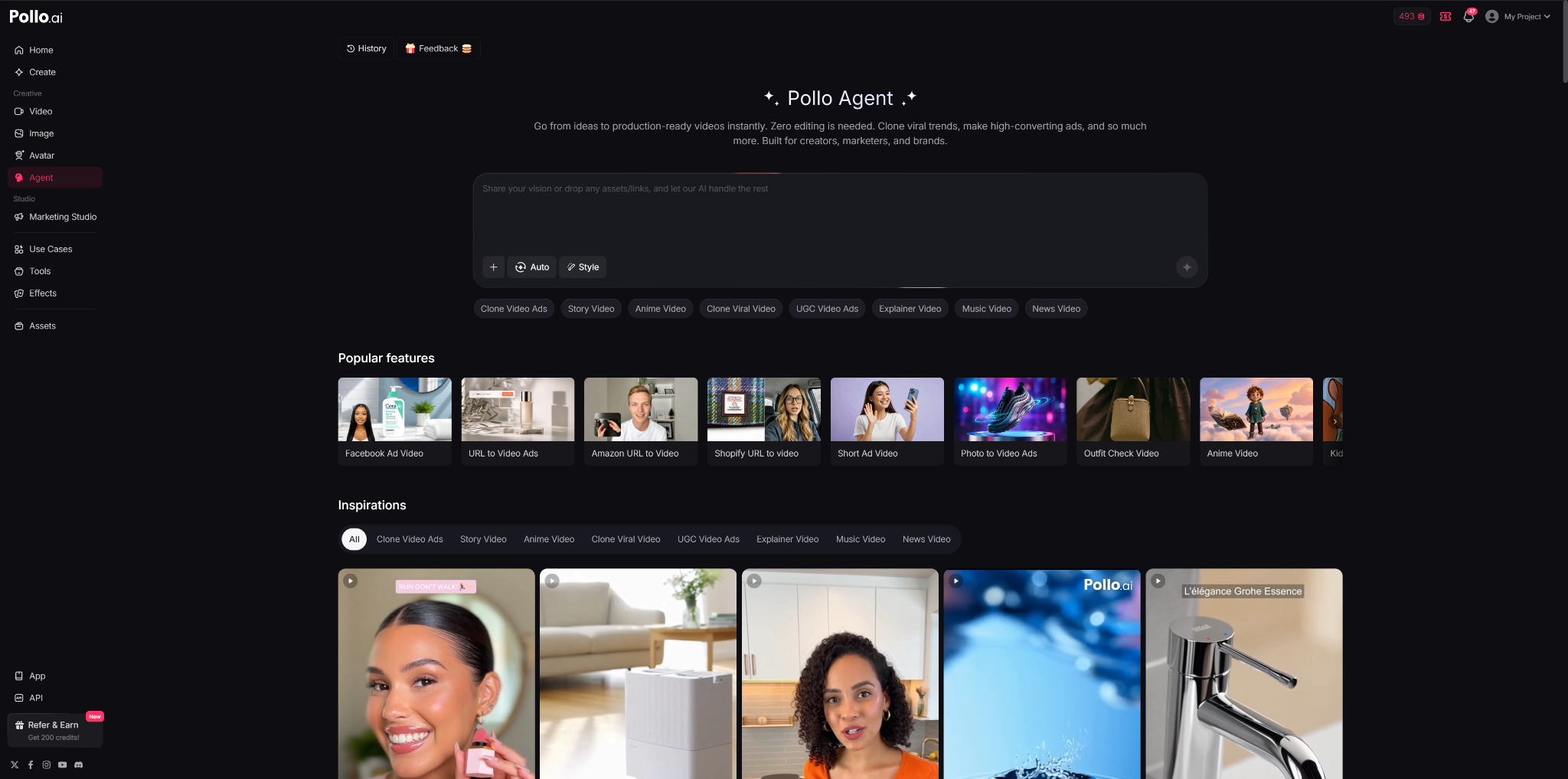
Pollo AI operates as an advanced multi-model aggregator that functions effectively as an autonomous, end-to-end AI video agent. The platform acts as a centralized brain, allowing creators to coordinate leading industry engines like Pollo 2.5, Seedance 2.0, Veo 3.1, and Sora 2 within a single interface, eliminating the need for multiple software subscriptions. Rather than generating fragmented, one-off clips that require manual editing and stitching, this intelligent agent interprets casual natural language directives—silently translating short text strings into detailed behind-the-scenes production instructions—to output complete, cohesive, and post-ready videos from start to finish.
The infrastructure is built to support iterative creative workflows, utilizing a smart contextual memory engine that keeps track of previous edits, visual directions, and asset references. This allows operators to refine and tweak clips naturally through simple chat commands without constantly re-explaining the project’s goals. Furthermore, its built-in Reference to Video modules and specialized tracking agents monitor character consistency and scene layouts frame-to-frame, while the agent’s multi-step processing effortlessly handles everything from Text to Video AI prompts to complex Image to Video AI transformations and Ghibli-style AI Animation generation.
Why Deploy the Pollo AI Video Agent for Scaled Marketing
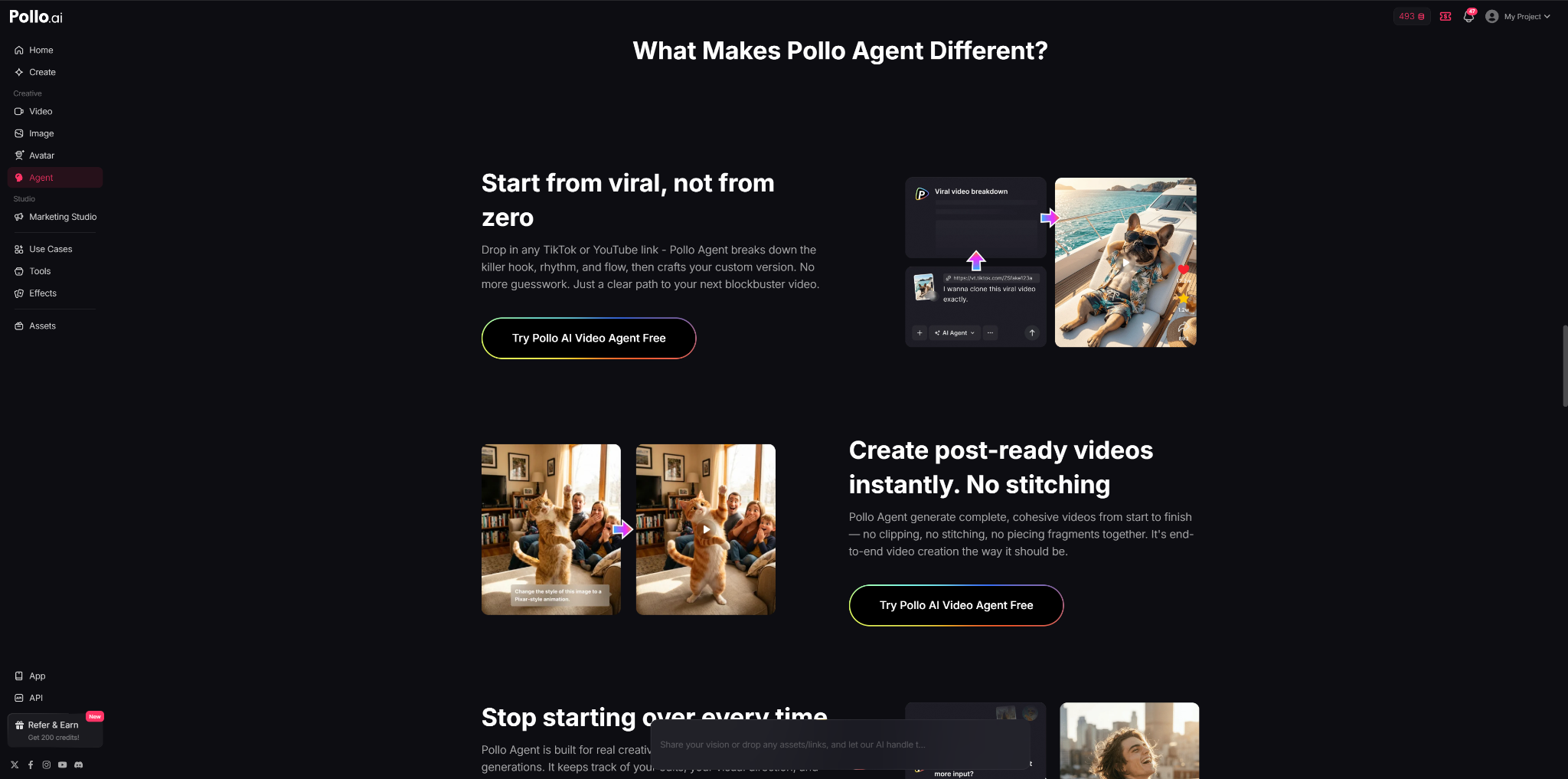
This platform provides exceptional utility for commercial operations due to its revolutionary “start from viral” framework, which allows users to drop in any TikTok or YouTube link so the agent can automatically analyze the killer hook, rhythm, and flow to craft a custom, high-converting variation. For SMBs, e-commerce teams, and short-video creators looking to cut production time by up to 75%, the Pollo Agent automates high-volume workflows like automated product promos, URL-to-Video Ads (supporting Amazon and Shopify links), UGC Video Ads, Clone Video Ads, and Facebook Ad Videos. Marketers can easily batch-generate platform-optimized creatives in high-quality 4K resolution to test multiple hooks and audiences across channels, while creative teams can deploy the agent to build Story Videos, Explainer Videos, Movie Trailers, and Photo-to-Video Avatars with zero manual timeline clipping required. It even functions as an effortless YouTube outro maker, helping channels generate polished, on-brand closing segments that drive subscriptions and boost watch-time retention.
My tips: Because the system aggregates a vast network of third-party foundational engines, generation queues may experience minor latency variations depending on the real-time processing demand of specialized sub-models like Veo or Sora.
2. Runway: The Advanced Multi-Agent Collaborative AI Video Agent
Runway has evolved its foundational architecture into a highly sophisticated environment where an automated AI video agent can collaborate with other specialized models to build complex cinematic worlds. The software is engineered for professional visual effects studios, filmmakers, and creative directors who require precise control over kinetic properties, architectural scale, and environmental consistency. The platform leverages large-scale multimodal datasets to analyze text prompts, translating detailed cinematic descriptions into high-resolution, structurally coherent moving imagery.
The agent framework allows users to establish distinct parameters for camera behavior, spatial rendering, and lighting dynamics across multi-shot sequences. The system effectively tracks complex temporal transformations, ensuring that atmospheric conditions, shadow directions, and human anatomy adjust logically as the virtual camera traverses a simulated space. Its underlying cognitive model reads detailed inputs regarding lens types and historical film styles, executing complex visual adjustments without requiring manual keyframing.
Why Deploy the Runway AI Video Agent for Creative Direction
The primary advantage of utilizing Runway lies in its granular spatial masking tools and powerful pre-visualization features, which allow creative teams to test complex visual concepts rapidly. Features like the Advanced Motion Brush act as localized sub-agents, empowering editors to select isolated regions of an asset for animation while keeping adjacent elements perfectly static. This capacity makes the platform an excellent fit for high-end commercial design, speculative movie trailers, and intricate world-building projects where strict artistic control is non-negotiable.
My tips: Operating this advanced cinematic system requires an understanding of professional lighting and camera terminology to achieve optimal, high-fidelity results.
3. HeyGen: The Conversational Interactive AI Video Agent
HeyGen is a highly specialized platform focused on the deployment of photorealistic human avatars that function as interactive, real-time communication systems. This specialized AI video agent is designed to replace traditional talking-head video setups, offering businesses an automated pipeline for generating customer support clips, personalized sales videos, and localized educational content. The system processes raw scripts or structured database inputs to output footage of a digital presenter speaking directly to the audience with exceptional lip-sync precision.
The engineering architecture is built heavily around automated voice cloning and natural language translation, enabling cross-border communication scaling. When a user uploads a script in one language, the system can instantly translate the text into dozens of alternative languages while retaining the original speaker’s vocal profile, pitch variations, and emotional nuance. This automated voice-and-video matching enables corporate enterprises to deploy a consistent visual ambassador across globally distributed marketing environments.
Why Deploy the HeyGen AI Video Agent for Enterprise Communications
HeyGen stands out as an efficient alternative to costly physical studio production by providing an extensive library of diverse stock avatars, professional wardrobe variations, and realistic office backgrounds. The agent can be integrated into automated customer outreach pipelines, drawing data directly from CRM software to generate personalized video messages for individual clients at scale. This capability makes it a highly valuable resource for customer success departments, international marketing teams, and e-learning developers who need to produce high volumes of presenter-led media efficiently.
My tips: The platform’s processing models are highly optimized for upright, stationary human presenters, making it unsuitable for generating high-velocity action footage or complex mechanical animations.
4. CapCut AI: The Agile Social-First AI Video Agent
CapCut AI leverages an accessible, highly intelligent automation framework designed specifically to streamline short-form content creation for modern social media platforms. This mobile-optimized AI video agent functions by scanning trending media layouts, analyzing user-uploaded raw files, and automatically constructing structured video assets that align with current platform algorithms. The system features a highly responsive script-to-video module that can draft a promotional narrative based on a basic product name and instantly source relevant B-roll footage to match the generated voiceover.
The software’s processing engine is engineered to handle rapid timeline operations, incorporating smart captioning agents that automatically transcribe dialogue into stylized, multi-lingual on-screen text overlays. Its internal computer vision models allow for automated object tracking, quick background removals, and localized filters that adapt instantly to changing facial expressions. This makes it an ideal option for creators who must maintain high-frequency posting schedules on channels like TikTok, Instagram, and YouTube Shorts.
Why Deploy the CapCut AI Video Agent for Short-Form Growth
The principal asset of CapCut AI is its ability to reduce the time between initial ideation and final platform export down to a few minutes. The system provides creators with immediate access to massive libraries of authorized audio tracks, dynamic visual transitions, and smart text effects that adapt fluidly to the pacing of the background music. This automated synchronization ensures that even users with zero technical editing background can generate highly engaging, visually polished short videos that capture audience attention within the first few seconds of playback.
My tips: Because the platform relies heavily on preset structures and trending styles, it offers less flexibility for creators seeking to build highly unique, non-standard cinematic compositions.
5. Synthesia: The Corporate Training and Development AI Video Agent
Synthesia operates as an enterprise-grade corporate platform that uses an advanced AI video agent framework to convert static documents, manuals, and text files into structured training media. The software is built primarily to serve human resource departments, compliance teams, and technical trainers who need to update corporate learning libraries frequently. The system allows users to feed long PDF files or instruction manuals directly into the interface, where the agent automatically extracts key informational points to generate a multi-scene presentation script.
The platform’s underlying avatar engine supports deep behavioral synchronization, producing natural micro-expressions, subtle head nods, and realistic hand movements that match the tone of the spoken text. Synthesia’s workspace provides collaborative editing environments where multiple team members can review script lines, adjust avatar positioning, and update supporting slide elements simultaneously. This structured approach to asset management ensures that informational accuracy is preserved across complex training programs.
Why Deploy the Synthesia AI Video Agent for Organizational Scaling
Synthesia provides distinct administrative advantages by enabling the rapid modification of existing training catalogs without requiring re-shooting sessions. If a corporate policy or product feature changes, an operator can simply edit the text script within the dashboard, prompting the agent to instantly re-render the affected video segments with updated vocal and visual delivery. This workflow optimization reduces long-term maintenance costs for companies operating vast internal databases across multiple geographic regions and regulatory jurisdictions.
My tips: The system’s rendering engine enforces strict corporate safety and content compliance filters, which may restrict the generation of highly experimental or stylized artistic content.
Conclusion
| Product Name | Core Agent Functionality | Best For | Price Range |
| Pollo AI | Viral link analysis, end-to-end video synthesis, multi-model choice | E-commerce teams, marketers, and viral short-form creators | Free tier available; Premium plans $10 – $60+/mo |
| Runway | Multi-agent collaboration, cinematic environment control, generative scripting | Advanced pre-visualization & filmmaking pipelines | Standard to Enterprise; $12 – $76+/mo |
| HeyGen | Interactive streaming avatars, autonomous script localization, conversational logic | Globalized marketing & automated sales outreach | Free trial; Paid tiers $24 – $72+/mo |
| CapCut AI | Script-to-video automation, rapid template intelligence, mobile optimization | Social media channels & agile content creation | Free basic features; Pro subscriptions $8 – $12/mo |
| Synthesia | Conversational corporate avatars, automated course building, multilingual translation | Enterprise training & internal communications | Personal to Custom Enterprise; $22 – $64+/mo |
Deploying an intelligent AI video agent helps modern production teams automate repetitive administrative and technical workflows, significantly reducing rendering timelines and overhead expenses. Selecting the right platform requires matching your organization’s creative goals with the specialized multi-model flexibility of Pollo AI, the cinematic control of Runway, or the structured communication frameworks of avatar-centric systems.
FAQ’s
1. What is an AI video agent?
An AI video agent is an advanced software system that can independently create, edit, and optimize video content based on a user’s goals. Unlike traditional video editing tools that require manual timeline editing, scene arrangement, and asset selection, an AI video agent acts more like a virtual production assistant. It can understand text instructions, generate visuals, add voiceovers, create transitions, and assemble a complete video with minimal human involvement.
For example, instead of spending hours editing a product advertisement, a user can simply provide a prompt such as “Create a 30-second Facebook ad promoting a fitness app for busy professionals,” and the AI video agent can generate the entire video automatically.
2. How does an AI video agent work?
AI video agents use technologies such as natural language processing, computer vision, and generative AI models to transform text prompts, images, URLs, or scripts into finished videos. They analyze the user’s objective, generate relevant media assets, assemble scenes, add audio, and optimize the final output for the intended platform.
3. What are the benefits of using an AI video agent?
AI video agents significantly reduce production time and costs while enabling businesses to create content at scale. They automate repetitive editing tasks, improve workflow efficiency, maintain brand consistency, and make professional-quality video creation accessible even to users with little or no editing experience.
4. Which AI video agent is best for marketing and advertising?
The best option depends on the specific use case, but platforms like Pollo AI are designed specifically for marketers and content creators. Features such as viral video analysis, automated ad generation, URL-to-video creation, and multi-model support help businesses produce high-converting marketing videos quickly and efficiently.
5. Can AI video agents create videos in multiple languages?
Yes. Many modern AI video agents support multilingual video creation. Platforms such as HeyGen and Synthesia can automatically translate scripts, generate voiceovers in multiple languages, and synchronize lip movements to match translated speech, making it easier for businesses to reach global audiences.
6. Are AI video agents suitable for businesses and corporate training?
Absolutely. Many organizations use AI video agents to create employee onboarding materials, compliance training, product tutorials, and internal communications. These platforms make it easy to update content whenever policies or procedures change, eliminating the need for costly reshoots.
7. Can AI video agents replace professional video editors?
AI video agents can automate many production tasks and dramatically speed up content creation, but they do not completely replace human creativity. For highly customized campaigns, cinematic productions, and complex storytelling projects, human expertise remains valuable. Most businesses achieve the best results by combining AI efficiency with human creative oversight.
8. What should businesses consider when choosing an AI video agent?
Businesses should evaluate factors such as ease of use, video quality, supported AI models, avatar capabilities, multilingual support, collaboration features, export options, and pricing. The ideal platform should align with the organization’s content goals, production volume, and budget while providing enough flexibility to support future growth.