
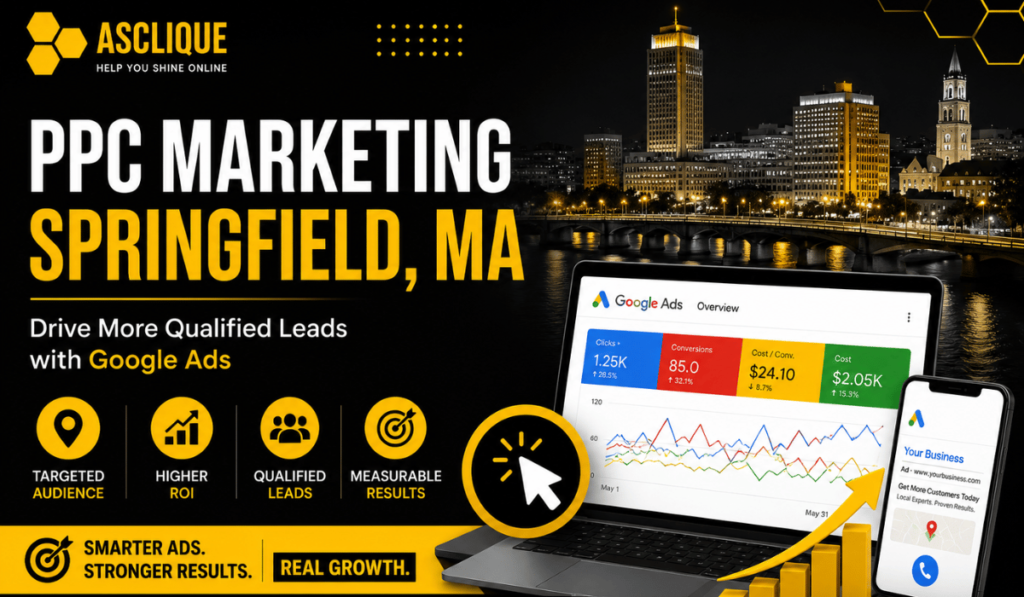
Many businesses in Springfield, Massachusetts already know that Google Ads can drive new customers, but simply running ads doesn’t guarantee profitable results. The difference between wasted ad spend and consistent lead generation is having the right strategy, targeting, and ongoing optimization. In this guide from Asclique Innovation and Technology, you’ll learn how PPC marketing works, why it matters for local businesses, and how to build campaigns that deliver measurable growth.
Key Takeaways
- PPC marketing is a paid advertising model that lets businesses appear at the top of search results and pay only when someone clicks their ad.
- Effective PPC campaigns combine keyword research, compelling ad copy, optimized landing pages, and continuous performance monitoring.
- Local PPC advertising helps Springfield, Massachusetts businesses reach nearby customers who are actively searching for their products or services.
- Professional PPC management improves lead quality, increases conversions, and reduces wasted advertising spend through ongoing optimization.
- Google Ads provides measurable performance data that helps businesses refine campaigns and maximize return on investment.
- Businesses that regularly optimize bids, keywords, audiences, and landing pages typically achieve stronger long-term PPC performance.
- Choosing an experienced PPC marketing agency like Asclique Innovation and Technology allows businesses to scale advertising more efficiently and confidently.
What Is PPC Marketing and How Does It Work?
PPC marketing is a digital advertising model in which businesses pay only when a user clicks on their advertisement. Instead of paying a flat fee for exposure, advertisers bid on keywords relevant to their business and are charged each time a searcher clicks through to their website. This makes PPC one of the most cost-controlled forms of digital advertising, since every dollar is tied to an actual visitor.
At its core, PPC works through an auction system: advertisers select keywords they want to target, set a maximum bid, and write ads that appear when someone searches those terms. For example, a Springfield HVAC company might bid on “emergency furnace repair Springfield MA.” so their ad appears the moment a local homeowner searches that exact phrase. Google then combines bid amount with ad quality to decide which ads appear and in what position.
PPC vs. SEO: What’s the Difference?
PPC and SEO both aim to increase visibility in search results, but they work in fundamentally different ways. SEO builds organic rankings over months through content, backlinks, and technical optimization, while PPC delivers placement immediately in exchange for payment per click. Businesses that need leads right away often start with PPC, then layer in local SEO to build long-term visibility that doesn’t disappear when ad spend stops. The two channels work best together: keyword data from a PPC campaign often strengthens an organic content strategy by revealing which search terms convert.
Google Ads dominates the paid search landscape, but Microsoft Ads (formerly Bing Ads) reaches a smaller, often less competitive audience with lower costs per click, and social platforms like Meta and LinkedIn round out the mix by targeting audiences by interest rather than search intent.
Why Is PPC Marketing Important for Businesses in Springfield, MA?
PPC marketing matters for Springfield businesses because it delivers immediate visibility and measurable leads in a competitive local market. Unlike organic strategies that build momentum gradually, a well-structured campaign can put a business at the top of search results the same day it launches. That’s a real advantage for businesses with seasonal demand, new locations, or urgent service needs like plumbers and electricians.
PPC offers immediate visibility for businesses that can’t wait months to rank organically, letting even a new Springfield restaurant appear above established competitors within hours of launch. It also accelerates lead generation, since ads target users actively searching for a product or service rather than passively browsing. Local businesses benefit from precise geographic targeting, too: campaigns can be geo-fenced to Springfield, Chicopee, and West Springfield so ad spend never reaches searchers outside the actual service area.
PPC is also highly measurable, giving business owners a level of transparency that radio or print advertising can’t offer, since every click and call ties back to a specific keyword and ad. Budget flexibility means a Springfield law firm can start with a modest monthly budget and scale up once campaigns prove profitable, without the long-term commitment traditional media requires.
How Can Google Ads Help Local Businesses in Springfield, Massachusetts?
Google Ads helps Springfield businesses connect with nearby customers at the exact moment they’re searching for a product or service. Because Google Ads uses location targeting, a Springfield-based contractor can ensure their ads only show to users within a set radius of their service area, keeping ad budgets focused on genuinely reachable customers.
For example, a Springfield dental practice targeting “emergency dentist near me” can layer in call extensions and location extensions directly within the ad, letting a potential patient call the office or find directions without clicking through to a website first. Local Service Ads, available for select industries like home services and legal, add another layer of trust by displaying a Google Guarantee badge next to the listing. Contractors, plumbers, and electricians see especially strong performance from this format.
What Types of PPC Campaigns Deliver the Best Results?
The PPC campaign type that delivers the best results depends on a business’s goals, though Google Search Ads generally produce the highest-intent leads for local service businesses. Each format serves a different stage of the customer journey.
| Campaign Type | Best For | Typical Use Case in Springfield |
| Google Search Ads | High-intent leads | “Plumber Springfield MA” searches |
| Display Ads | Brand awareness | Retargeting site visitors with visual banners |
| Shopping Ads | Product-based businesses | Retail and eCommerce stores selling online |
| Performance Max | Cross-channel reach | Businesses wanting automated bidding across Google’s network |
| YouTube Ads | Storytelling and awareness | Restaurants or service businesses showcasing their work |
| Remarketing Campaigns | Re-engaging past visitors | Law firms nurturing leads who didn’t convert |
| Local Service Ads | Verified local leads | Home services, legal, and healthcare providers |
Google Search Ads and Remarketing
Search Ads appear when someone types a query directly into Google, making them the most direct match between intent and offer. A Springfield law firm bidding on “personal injury lawyer Springfield MA” reaches someone actively looking for legal representation, not someone casually browsing, which is why most businesses should invest here first. Remarketing campaigns then re-engage visitors who left a website without converting, keeping a business visible as that person browses elsewhere online. A successful PPC campaign involves strategic keyword research, audience targeting, compelling ad copy, optimized landing pages, and continuous performance optimization, the exact framework the team at Asclique Innovation and Technology follows for every client.
What Factors Affect the Success of a Google Ads Campaign?
The success of a Google Ads campaign depends primarily on keyword relevance, ad quality, landing page experience, and ongoing optimization. Google assigns every ad a quality score based on these factors, and a higher score can lower the cost per click while improving ad position, meaning two businesses bidding the same amount can see very different results.
Keyword relevance ensures ads only trigger for searches that match actual business offerings. Ad copy quality directly affects click-through rate, with the average Search Ads CTR sitting near 3.17% across industries (Source: Store Growers, 2026). And landing page experience determines whether a click actually converts, since sending traffic to a slow or irrelevant page kills conversion rates regardless of how strong the ad itself performs. A fast, well-built landing page guides visitors toward a clear call-to-action.
Why Should You Hire a PPC Marketing Company in Springfield, MA?
Hiring a PPC marketing company in Springfield, MA gives businesses access to professional campaign management, advanced tools, and continuous optimization that most in-house teams don’t have time to execute properly. Agencies like Asclique Innovation and Technology manage campaigns daily, adjusting bids and keywords in response to real-time performance data rather than checking in once a month.
Professional management typically improves quality score through structured keyword grouping and tightly matched ad copy, which lowers cost per click. Agencies also focus on better return on ad spend by continuously testing which keywords actually generate revenue, not just clicks, and reduce wasted budget by pausing underperforming keywords before they drain the monthly budget. Conversion tracking measures the actions users take after clicking an advertisement, allowing the Asclique Innovation and Technology team to accurately calculate return on advertising spend (ROAS) and translate raw numbers into decisions a business owner can act on.
What Are the Most Common PPC Mistakes Businesses Make?
The most common PPC mistakes businesses make include poor keyword targeting, ignoring negative keywords, and sending traffic to a generic homepage instead of a dedicated landing page. These mistakes are avoidable, but they quietly drain ad budgets for months before anyone notices the pattern.
- Poor keyword targeting: bidding on broad terms that attract unqualified clicks instead of specific, high-intent phrases.
- Ignoring negative keywords: failing to exclude irrelevant searches, which wastes budget on clicks that will never convert.
- Weak landing pages: sending paid traffic to a page that doesn’t match the ad’s promise or lacks a clear call-to-action.
- No conversion tracking: running campaigns without measuring which clicks actually turn into leads or sales.
- Sending traffic to the homepage: instead of a dedicated, relevant landing page built for that specific offer.
- Not testing ads: running a single ad variation indefinitely instead of A/B testing headlines and copy.
- Poor budget allocation: spreading budget evenly across keywords instead of investing more in top performers.
For example, a Springfield retail store bidding on the single word “shoes” without negative keywords might pay for clicks from people searching “shoe repair” or “shoe donation,” neither of which will ever convert. Regular optimization through bid adjustments, negative keywords, audience refinement, and A/B testing helps improve PPC performance and reduce advertising costs over time.
Which Industries Benefit Most from PPC Marketing in Springfield, Massachusetts?
Home service businesses, healthcare practices, law firms, and contractors tend to benefit most from PPC marketing in Springfield due to high-intent, urgent search behavior among their customers. Retail and eCommerce businesses also perform well through shopping ads that display product images and pricing directly in search results, while restaurants benefit from location-based campaigns that drive foot traffic during specific dayparts, like lunch or weekend brunch. Legal and financial firms often see higher costs per click but correspondingly higher customer lifetime value, which can still make PPC worthwhile despite the premium.
How Can You Measure the ROI of a PPC Campaign?
ROI on a PPC campaign is measured by comparing total ad spend against the revenue generated from conversions tracked through that campaign. This requires setting up conversion tracking before launching any campaign, since data collected retroactively is far less reliable than data captured from day one. Businesses need to define what counts as a conversion, whether that’s a phone call, form submission, or purchase, and then use tools like Google Analytics 4 and Google Tag Manager to track behavior from ad click through to conversion. Call tracking software can attribute inbound phone calls to the specific keyword and ad that generated them, giving service businesses a clearer ROI picture than form submissions alone.
How Long Does It Take to See Results from PPC Advertising?
Most PPC campaigns generate initial clicks and leads within the first few days of launch, though meaningful optimization typically takes four to eight weeks to fully mature, since Google’s algorithm needs a data collection period to understand which keywords, audiences, and ad variations perform best. A Springfield business might see phone calls within 48 hours of launch, but achieving a consistently profitable cost per lead often takes a full month of bid adjustments and negative keyword additions. That patience tends to pay off in stronger long-term performance.
PPC Tools, Examples & Best Practices
Professional PPC management relies on platform-native tools and third-party software to plan, execute, and measure campaigns effectively.
- Google Ads: the primary platform for creating and managing Search, Display, Shopping, and Performance Max campaigns.
- Google Analytics 4: tracks user behavior on-site after the click, revealing which pages and actions drive conversions.
- Google Tag Manager: manages tracking codes without needing a developer for every website change.
- Google Keyword Planner: a free tool for researching keyword search volume and estimated cost per click.
- Looker Studio: builds visual, shareable reports that translate campaign data into client-friendly dashboards.
- SEMrush and SpyFu: competitive research tools that reveal which keywords competitors are bidding on.
- Call tracking software: attributes phone calls back to specific ads and keywords for accurate ROI measurement.
For example, a Springfield home services company might use SpyFu to identify which keywords a competitor is bidding on, then build a campaign around underserved terms with better conversion potential.
Conclusion
PPC marketing gives Springfield, Massachusetts businesses a direct, measurable path to new customers, but only when campaigns are built on solid keyword research, strong landing pages, and continuous optimization. Businesses that treat PPC as a “set it and forget it” tactic typically waste budget, while those who invest in expert management see stronger leads and better returns over time. Asclique Innovation and Technology can help you build a tailored Springfield PPC strategy that grows your business.
Frequently Asked Questions
What is PPC marketing, and how does it work?
PPC marketing is a paid advertising model where businesses bid on keywords and pay only when someone clicks their ad, with Google combining bid amount and ad quality to decide placement.
Why is PPC marketing important for businesses in Springfield, MA?
PPC delivers immediate visibility, faster lead generation, and precise local targeting, letting Springfield businesses compete for customers without waiting months for organic results.
How can Springfield, Massachusetts local companies benefit from Google Ads?
Google Ads uses location targeting, call extensions, and Local Service Ads to connect Springfield businesses with nearby customers at the exact moment they’re searching.
What types of PPC campaigns deliver the best results?
Google Search Ads typically deliver the highest-intent leads, while remarketing, shopping, display, and local service ads support different stages of the customer journey.
What elements influence a Google Ads campaign’s success?
Keyword relevance, ad copy quality, landing page experience, and a strong quality score all directly influence cost per click and campaign performance.
Why should you hire a PPC marketing company in Springfield, MA?
An experienced agency such as Asclique Innovation and Technology improves quality score, reduces wasted budget, and provides expert reporting that’s difficult to replicate in-house.
How long does it take for PPC advertising to show results?
Initial clicks and leads often appear within days, but campaigns typically need four to eight weeks of optimization to reach consistent, profitable performance.