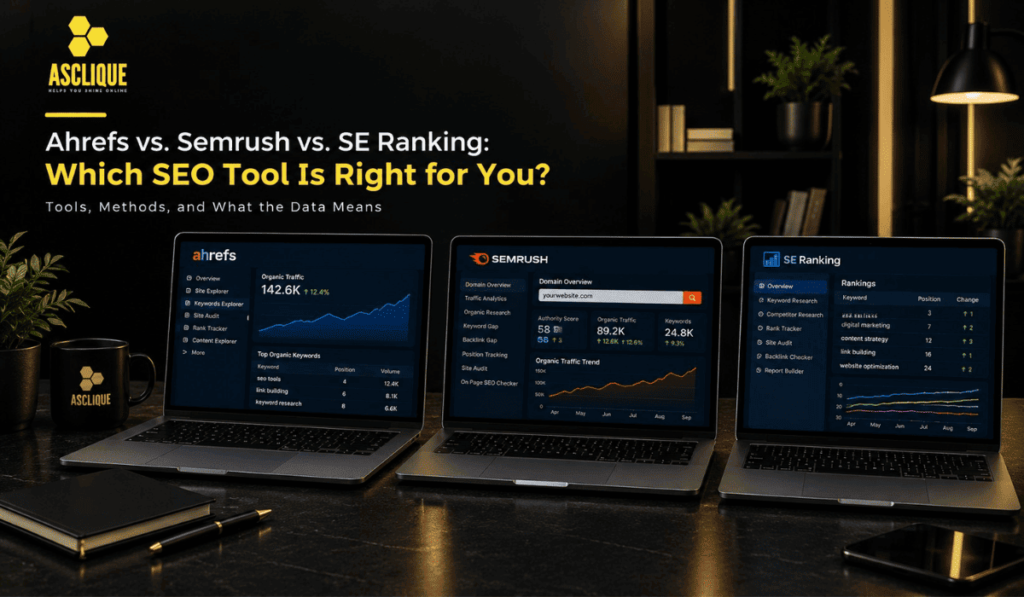
Ahrefs is particularly useful for backlink research and organic competitor analysis. Semrush offers a broader digital marketing toolkit that combines SEO with advertising research, content optimization, and AI search visibility. SE Ranking provides a practical combination of SEO tools, rank tracking, and agency reporting capabilities.
However, choosing the most expensive platform does not automatically produce better SEO results. The right tool depends on your website, the number of projects you manage, the information you need, and how your team uses that information.
This guide compares Ahrefs vs. Semrush vs. SE Ranking across their major features, pricing considerations, strengths, limitations, and practical use cases. It also explains which platform may be the better choice for freelancers, agencies, small businesses, and in-house SEO teams.
Quick Answer
Ahrefs is a strong choice for backlink analysis and organic SEO research, Semrush is better suited to teams that need a broader digital marketing platform, and SE Ranking is a practical option for businesses and agencies prioritizing rank tracking, reporting, and cost control.
Choose Ahrefs if backlink analysis, competitor research, and identifying content opportunities are central to your SEO workflow.
Choose Semrush if your team manages SEO alongside PPC research, content marketing, competitor intelligence, and AI search visibility.
Choose SE Ranking if you need reliable SEO fundamentals, location-specific rank tracking, and client reporting without necessarily investing in a larger marketing platform.
No platform is universally more accurate or effective across every feature. Keyword databases, backlink indexes, ranking updates, project limits, and reporting capabilities should be evaluated according to your actual requirements.
Best overall approach: Identify your most important SEO workflows first, compare the available plans, and test each platform using the same website, keywords, and competitors before making a long-term commitment.
Key Facts and What Is Verified
- Core SEO functionality: All three platforms provide keyword research, backlink analysis, website auditing, and rank tracking.
- Ahrefs: Offers Site Explorer, Keywords Explorer, Site Audit, Rank Tracker, Content Explorer, and AI visibility capabilities.
- Semrush: Combines SEO research with advertising intelligence, content workflows, reporting, and AI visibility features.
- SE Ranking: Provides keyword tracking, competitive research, website auditing, backlink analysis, and agency-oriented reporting tools.
- Rank tracking: Update frequency depends on the platform and subscription. Standard Ahrefs Rank Tracker updates are generally weekly, while Semrush offers daily tracking.
- Backlink data: Each platform maintains its own database. Backlink counts can differ because of crawling, indexing, and reporting methodologies.
- Keyword difficulty: Scores are proprietary estimates and should not be compared as identical measurements.
- Organic traffic estimates: Competitor traffic figures are modeled estimates, not direct access to another website’s Google Analytics account.
- AI search visibility: Available capabilities and limits vary by platform and subscription.
- Pricing: Subscription prices, user seats, credits, add-ons, and project limits can change.
- Google rankings: Purchasing an SEO tool does not directly improve rankings. Results depend on how its insights are implemented.
Table of Contents
- Ahrefs vs. Semrush vs. SE Ranking: Quick Comparison
- What Is Ahrefs?
- What Is Semrush?
- What Is SE Ranking?
- Pricing Comparison
- Keyword Research Comparison
- Backlink Analysis Comparison
- Technical SEO and Site Auditing
- Rank Tracking Comparison
- Competitor Analysis
- AI Search Visibility and AI SEO Features
- Reporting and Agency Management
- Which SEO Tool Should You Choose?
- A Practical Asclique Workflow
- Weak Approach vs. Better Approach
- Common Mistakes When Choosing SEO Software
- What Is Not Proven
- How to Measure SEO Tool ROI
- SEO Tool Selection Checklist
- Frequently Asked Questions
- Asclique Recommendation
Ahrefs vs. Semrush vs. SE Ranking: Quick Comparison
All three platforms can support a complete SEO workflow. The main differences become clearer when comparing their primary strengths and intended users.
| Feature | Ahrefs | Semrush | SE Ranking |
|---|---|---|---|
| Primary Strength | Backlink and organic search research | Broad marketing and competitor intelligence | SEO management and reporting value |
| Keyword Research | Strong | Strong | Comprehensive core features |
| Backlink Analysis | Major strength | Extensive capabilities | Core backlink research and monitoring |
| Site Auditing | Yes | Yes | Yes |
| Rank Tracking | Weekly standard updates | Daily tracking | Daily tracking options |
| PPC Competitor Research | Limited compared with dedicated advertising tools | Major strength | Selected competitive advertising data |
| AI Visibility | Available; broader monitoring may require additional products | Dedicated AI visibility capabilities | AI visibility features and add-ons |
| Agency Reporting | Available; check plan and add-on limits | Advanced reporting options | Agency-focused reporting options |
| Typical Fit | SEO specialists and link researchers | Marketing teams and multi-channel agencies | Small businesses, freelancers, and SEO agencies |
Important: These are practical positioning differences, not independent performance-test results. Specific capabilities depend on the subscription selected.
What Is Ahrefs?
Ahrefs is an SEO and competitive intelligence platform used for researching keywords, analyzing backlinks, monitoring organic competitors, auditing websites, and tracking search visibility.
Its major tools include Site Explorer, Keywords Explorer, Site Audit, Rank Tracker, and Content Explorer.
Ahrefs’ Main Strengths
Ahrefs is particularly useful when a substantial part of your SEO work involves analyzing links and understanding why competing pages attract organic visibility.
Site Explorer allows users to investigate referring domains, backlinks, top-performing pages, and organic keyword opportunities. Content Explorer can help identify resources that have attracted backlinks or organic traffic.
Keywords Explorer provides search volume estimates, keyword difficulty, traffic potential, and related keyword ideas.
Where Ahrefs May Be Less Suitable
Ahrefs may be less suitable for teams whose primary requirements involve advertising campaign research, social media management, or frequent client-facing rank reports.
Its standard weekly rank tracking cadence may also be a limitation for agencies that need daily keyword movement data.
Some advanced capabilities, additional users, or broader AI visibility monitoring can increase the overall subscription cost.
Who Should Consider Ahrefs?
Ahrefs is a strong candidate for technical SEO specialists, link-building teams, content strategists, and agencies conducting detailed organic competitor research.
What Is Semrush?
Semrush is a digital marketing platform that combines SEO research with competitive intelligence, advertising analysis, content workflows, reporting, and AI search visibility capabilities.
Its SEO tools include Keyword Magic Tool, Organic Research, Keyword Gap, Backlink Analytics, Site Audit, and Position Tracking.
Semrush’s Main Strengths
Semrush is particularly useful for businesses managing several marketing channels.
For example, a marketing agency may use Semrush to research organic keywords, review competitors’ advertising activity, identify content opportunities, monitor rankings, and prepare performance reports.
This broader coverage can reduce the need to move between separate research platforms.
Where Semrush May Be Less Suitable
Semrush can be more complex than necessary for businesses that only need basic keyword tracking or occasional website audits.
Some features are distributed across different plans, toolkits, or add-ons. Businesses should calculate the total cost of the capabilities they actually need.
Who Should Consider Semrush?
Semrush is well suited to in-house marketing departments, established agencies, and businesses combining organic SEO with PPC research, content marketing, and broader competitive analysis.
What Is SE Ranking?
SE Ranking is an SEO platform offering keyword tracking, keyword research, competitor analysis, website auditing, backlink monitoring, and reporting tools.
It is often considered by businesses and agencies that want comprehensive SEO functionality without necessarily purchasing a broader marketing intelligence platform.
SE Ranking’s Main Strengths
SE Ranking provides practical tools for monitoring keyword positions, reviewing website health, researching competitors, and producing SEO reports.
Its agency-oriented features can be useful for teams managing multiple client websites.
For example, an agency managing several local service businesses may prioritize location-specific keyword tracking, recurring audits, and reports that clearly explain changes in organic visibility.
Where SE Ranking May Be Less Suitable
Businesses conducting highly specialized backlink research or requiring extensive advertising intelligence should compare SE Ranking’s available data and reporting depth with Ahrefs and Semrush.
Advanced agency features, AI visibility monitoring, or additional usage allowances may require particular plans or add-ons.
Who Should Consider SE Ranking?
SE Ranking is a practical option for freelancers, small businesses, local SEO specialists, and agencies managing multiple websites with recurring SEO reporting requirements.
Ahrefs vs. Semrush vs. SE Ranking Pricing Comparison
Pricing is an important consideration, but the advertised monthly subscription price does not always reflect the total cost of using an SEO platform.
Businesses should account for tracked keywords, projects, crawl allowances, user seats, reporting capabilities, API access, and optional toolkits.
Pricing Overview
| Pricing Factor | Ahrefs | Semrush | SE Ranking |
|---|---|---|---|
| Pricing Position | Premium SEO platform | Premium marketing platform | Often positioned as a lower-cost alternative |
| Entry-Level Access | Limited entry options and paid subscriptions | Free access limitations and paid subscriptions | Paid plans with trial options |
| Additional Costs | Seats, usage limits, and selected add-ons | Additional toolkits, seats, and reporting features | Additional users, agency features, and selected add-ons |
| Best Budget Consideration | Value from specialized SEO research | Value from multiple marketing functions | Value from core SEO and reporting workflows |
Because subscription structures change, confirm current prices and included features directly on the providers’ official pricing pages before purchasing.
Ahrefs Pricing | Semrush Pricing | SE Ranking Pricing
How to Compare the Actual Cost
Consider an agency managing 15 client websites.
The agency may need to track hundreds of keywords, run recurring technical audits, and produce monthly reports.
A subscription with a lower advertised price may become more expensive after adding the necessary projects, keywords, users, or reporting features.
Conversely, a more expensive platform may be worthwhile if it replaces several separate tools already used by the agency.
The better comparison is the total monthly cost of completing your actual workflow, not simply the lowest advertised subscription.
Keyword Research: Ahrefs vs. Semrush vs. SE Ranking
Keyword research is one of the most important features of any SEO platform.
All three tools provide keyword ideas, search volume estimates, keyword difficulty metrics, and competitor research capabilities.
However, they organize and interpret this information differently.
Ahrefs Keyword Research
Ahrefs Keywords Explorer provides keyword suggestions, estimated search volume, keyword difficulty, clicks data, traffic potential, and related keyword groupings.
Traffic Potential is particularly useful because a page may rank for many related keywords rather than receiving traffic from only one search term.
For example, a guide targeting “technical SEO checklist” may also rank for related searches involving website audits, indexing problems, and technical optimization.
Analyzing the traffic potential of the ranking page can provide additional context beyond the volume of the primary keyword.
Semrush Keyword Research
Semrush Keyword Magic Tool offers keyword suggestions with filtering options for search intent, keyword difficulty, search volume, and other metrics.
Keyword Gap helps compare the organic keyword visibility of competing domains.
This can be useful when planning content around topics competitors already cover but your website does not.
Semrush is also useful when organic keyword research needs to be connected with advertising research.
SE Ranking Keyword Research
SE Ranking provides keyword suggestions, search volume estimates, difficulty metrics, and competitive keyword information.
Its research tools can support common workflows such as identifying service-related keywords, evaluating search demand, and monitoring competitors.
For many smaller websites, the available functionality may be sufficient without requiring a more expensive platform.
Which Tool Is Better for Keyword Research?
Ahrefs is a strong choice for researching organic traffic potential and evaluating the pages already performing in search results.
Semrush is particularly useful for keyword segmentation, competitive research, and connecting organic search with advertising intelligence.
SE Ranking is a practical choice for teams that need keyword research alongside recurring tracking and reporting.
Recommendation: Test the same group of keywords in all three tools. Compare relevant suggestions, SERP analysis, search intent, and how easily the data supports your content planning process.
For additional techniques, read Asclique’s advanced keyword research guide.
Backlink Analysis: Which SEO Tool Is Better?
Backlink analysis helps SEO professionals understand which websites link to a domain, identify lost links, evaluate competitors, and discover potential editorial opportunities.
Ahrefs, Semrush, and SE Ranking all provide backlink research capabilities, but their databases and interfaces differ.
Ahrefs Backlink Analysis
Ahrefs Site Explorer provides detailed information about backlinks, referring domains, anchor text, and new or lost links.
Its Link Intersect feature can help identify websites linking to competitors but not to your website.
For example, a business may discover that several industry publications reference competing guides but have never linked to its own resources.
This information can help identify potential outreach opportunities, provided the business has something genuinely useful to offer those publishers.
Semrush Backlink Analysis
Semrush offers Backlink Analytics, Backlink Gap, and backlink monitoring capabilities.
Backlink Gap allows users to compare referring domains across competing websites.
Semrush can be particularly useful when backlink analysis forms part of a broader competitive marketing review.
SE Ranking Backlink Analysis
SE Ranking provides backlink research and monitoring tools for reviewing referring domains, link changes, and backlink profiles.
Its capabilities may be sufficient for businesses that need recurring backlink monitoring rather than highly specialized link research.
Which Platform Has the Best Backlink Database?
There is no reliable universal winner for every website and market.
Different platforms discover, process, and retain backlinks differently.
One tool may identify more links for a particular website, while another may provide more useful information about a different competitor.
Ahrefs is a strong candidate for backlink-intensive workflows, but businesses should test relevant domains rather than relying entirely on published database-size claims.
Recommendation: If link building is central to your strategy, prioritize backlink discovery, filtering, referring-domain analysis, and historical link information.
Once you identify opportunities, Asclique’s guide on creating high-quality backlinks explains the importance of relevant editorial links.
Need More Than SEO Tool Reports?Turn keyword research, backlink analysis, and technical SEO findings into a strategy focused on qualified traffic and business growth. | Contact Asclique |
Technical SEO and Site Auditing Comparison
Technical SEO auditing helps identify problems that may affect crawling, indexing, website accessibility, and search performance.
All three platforms provide website crawlers that can identify common technical issues.
Ahrefs Site Audit
Ahrefs Site Audit can identify broken links, redirect problems, missing metadata, duplicate content, and other technical SEO issues.
Its reports help users investigate website structure and prioritize technical improvements.
Ahrefs may be particularly suitable for teams conducting detailed technical audits or working with larger websites, depending on the crawl allowances included in their plan.
Semrush Site Audit
Semrush Site Audit provides technical issue reports, site health information, and recommendations for investigating website problems.
Its interface can help marketing teams understand technical SEO findings without requiring every user to be a developer.
Semrush also offers related tools that can support broader optimization workflows.
SE Ranking Website Audit
SE Ranking’s website audit tools help identify technical SEO problems and organize findings for review.
Its reporting capabilities may be useful for agencies that regularly audit multiple client websites.
Which Tool Is Best for Technical SEO?
All three can identify many common technical SEO problems.
The better choice depends on the size of your website, crawl limits, reporting needs, and the level of technical detail required.
For a small business website with 30 pages, all three platforms may provide sufficient auditing capabilities.
For a large ecommerce website with thousands of product pages, crawl allowances, JavaScript rendering, URL filtering, and issue exports may become more important.
Important: An audit score is not a Google ranking factor. Fixing every warning does not guarantee higher rankings.
Rank Tracking: Ahrefs vs. Semrush vs. SE Ranking
Rank tracking allows businesses to monitor how their website appears for selected keywords across search engines, devices, and geographic locations.
This is particularly important for SEO agencies managing client campaigns.
Ahrefs Rank Tracker
Ahrefs Rank Tracker monitors keyword positions and provides information about ranking changes, visibility, and competing websites.
Standard tracking updates are generally weekly.
This may be sufficient for businesses reviewing SEO performance over longer periods.
However, agencies that require daily ranking reports should consider whether this update frequency meets their needs.
Semrush Position Tracking
Semrush Position Tracking provides daily keyword monitoring and competitive visibility information.
It can help teams identify changes in search positions and monitor selected SERP features.
This is useful for campaigns where frequent reporting and competitor comparisons are important.
SE Ranking Rank Tracking
SE Ranking offers keyword position monitoring with location and device targeting options.
Daily tracking capabilities make it a practical choice for agencies and businesses that regularly review ranking performance.
However, the number of tracked keywords, search engines, and locations may affect the subscription required.
Which Rank Tracker Should You Choose?
For businesses primarily reviewing monthly SEO trends, Ahrefs may provide sufficient tracking.
For agencies needing daily updates and broader competitive visibility reports, Semrush is worth considering.
For agencies prioritizing keyword tracking and recurring client reports, SE Ranking may offer a practical combination of features and cost.
Read Asclique’s guide to tracking Google rankings for additional information about monitoring search performance.
Competitor Analysis: Which Platform Provides Better Insights?
Competitor analysis is one of the most valuable applications of SEO software.
It helps businesses identify competing pages, content gaps, backlink opportunities, and changes in search visibility.
Ahrefs for Organic Competitor Research
Ahrefs is particularly useful for investigating organic keywords, competing pages, and backlink relationships.
Its research tools can help identify which pages attract estimated organic traffic and which referring domains link to competing resources.
Semrush for Broader Competitive Intelligence
Semrush combines organic competitor research with advertising and broader market intelligence tools.
This can be valuable for businesses that want to understand both organic search competition and paid advertising activity.
SE Ranking for Practical SEO Competitor Monitoring
SE Ranking provides competitive research capabilities that help businesses review keyword visibility and competing websites.
It can be useful for ongoing monitoring, particularly when the primary objective is tracking SEO performance rather than analyzing several marketing channels.
Practical Example
Consider a plumbing company trying to improve visibility for “emergency plumber Sydney.”
The company could use an SEO platform to identify competing pages, review their content, investigate relevant backlinks, and monitor keyword positions.
However, the software cannot independently determine whether the company provides better services or whether its website will convert visitors into customers.
The data must be interpreted in the context of the business and its market.
AI Search Visibility: Ahrefs vs. Semrush vs. SE Ranking
SEO platforms are expanding beyond traditional search rankings to include visibility in AI-generated answers and search experiences.
This includes monitoring brand mentions, citations, and appearances across selected AI search platforms.
Ahrefs AI Visibility Features
Ahrefs provides AI search research and monitoring capabilities, including Brand Radar.
These tools can help businesses investigate how brands and websites appear in selected AI search environments.
However, broader monitoring may require additional subscriptions or products.
Semrush AI Visibility Features
Semrush offers dedicated AI visibility capabilities that help businesses investigate brand presence in AI-generated search experiences.
These features can support research into AI search topics, brand mentions, and competitive visibility.
The exact capabilities available depend on the subscription and toolkit.
SE Ranking AI Visibility Features
SE Ranking also offers AI-related search visibility capabilities.
Businesses considering these features should check which AI platforms, prompts, geographic markets, and reporting options are supported.
Can These Tools Guarantee AI Search Citations?
No.
AI visibility tools can monitor selected responses and provide research insights, but they cannot guarantee that a website will be cited by ChatGPT, Google AI Overviews, Perplexity, or other AI systems.
AI-generated answers may vary depending on the prompt, location, model, and timing.
Businesses should treat AI visibility reports as monitoring data rather than guaranteed measurements of every possible AI response.
Reporting and Agency Management
For agencies, reporting can be just as important as keyword research or backlink analysis.
A platform may provide excellent SEO data but still be inefficient if producing client reports requires extensive manual work.
Ahrefs Reporting
Ahrefs provides reporting and data export capabilities, with additional reporting options depending on the plan and available add-ons.
It is useful for presenting backlink research, keyword performance, and technical SEO findings.
Semrush Reporting
Semrush provides reporting tools that can combine information from different marketing activities.
This may be useful for agencies managing SEO alongside PPC or other digital marketing services.
Branded reporting and automated delivery capabilities should be checked against the selected subscription.
SE Ranking Reporting
SE Ranking offers reporting features designed to support recurring SEO management.
Agency-oriented options can help teams prepare client-facing reports and monitor multiple projects.
White-label functionality and reporting limits may depend on the subscription.
What Should Agencies Compare?
Before choosing a platform, agencies should evaluate the number of projects, keyword allowances, user access, scheduled reports, branding options, and the time required to prepare monthly updates.
A platform that saves several hours of reporting work each month may justify a higher subscription cost.
Which SEO Tool Should You Choose?
The best platform depends on the work you perform most frequently.
Choose Ahrefs If…
- Backlink analysis is central to your SEO strategy.
- You regularly investigate organic competitors.
- You need detailed information about referring domains and competing pages.
- Your team focuses primarily on organic search rather than PPC.
- You want research tools for identifying link-worthy content opportunities.
Choose Semrush If…
- You manage SEO alongside PPC research or other marketing channels.
- You need broad competitive intelligence.
- Daily keyword tracking is important.
- Your team uses content planning and optimization tools.
- You want SEO and AI visibility research within a broader marketing platform.
Choose SE Ranking If…
- You manage several small or medium-sized websites.
- Recurring keyword tracking is a major requirement.
- You need practical client reporting capabilities.
- You want core SEO functionality while controlling software costs.
- Your team does not require every advanced feature of a larger platform.
Should You Use More Than One SEO Tool?
Using multiple platforms can be useful when each serves a distinct purpose.
For example, an agency might use Ahrefs for detailed backlink research and another platform for recurring rank tracking.
However, paying for overlapping subscriptions without using their unique features can create unnecessary costs.
Before adding another platform, identify the specific problem your current software cannot solve.
A Practical Asclique Workflow for Choosing SEO Software
Asclique recommends selecting SEO software based on the actual work required to improve search visibility and generate business results.
- Identify: List your most important SEO activities, including keyword research, backlink analysis, site auditing, rank tracking, and reporting.
- Prioritize: Determine which activities consume the most time or have the greatest effect on your SEO decisions.
- Compare: Review the features and limits available in each platform’s relevant subscription.
- Test: Analyze the same website, competitors, and keywords using each shortlisted platform.
- Evaluate: Compare data usefulness, reporting clarity, workflow efficiency, and total subscription costs.
- Implement: Configure projects, keyword tracking, technical audits, and reporting workflows.
- Measure: Track how the software helps identify and resolve meaningful SEO opportunities.
- Review: Reassess the subscription periodically to determine whether the platform still meets your needs.
The objective is not to collect more SEO data. It is to make better decisions and implement improvements more efficiently.
Weak Approach vs. Better Approach
| Weak Approach | Better Approach | Why It Is Better |
|---|---|---|
| Choose the tool with the largest advertised database. | Test relevant websites and keywords. | Evaluates usefulness for your actual market. |
| Compare only monthly subscription prices. | Calculate total costs, including add-ons and users. | Provides a more realistic budget comparison. |
| Assume all keyword difficulty scores are identical. | Review each tool’s methodology and actual SERPs. | Avoids misleading comparisons. |
| Generate reports without taking action. | Connect findings to prioritized SEO improvements. | Turns research into implementation. |
| Pay for several tools with overlapping features. | Use additional platforms only for clear workflow gaps. | Reduces unnecessary software spending. |
Common Mistakes When Choosing SEO Software
- Choosing based on popularity: A widely used platform is not necessarily the best fit for your business.
- Ignoring subscription limits: Project allowances, keyword tracking limits, and user seats can affect total costs.
- Assuming estimated traffic is exact: Third-party platforms model competitor traffic rather than accessing private analytics data.
- Comparing proprietary scores directly: Keyword difficulty and authority metrics use different methodologies.
- Overlooking reporting requirements: Agencies may need recurring reports, branding, and multiple-user access.
- Ignoring local SEO requirements: Businesses targeting specific cities or neighborhoods may need more granular location tracking.
- Buying unnecessary add-ons: Advanced features are only valuable when they support actual workflows.
- Expecting software to perform SEO automatically: Research tools identify opportunities, but implementation and quality control remain necessary.
What Is Not Proven
No independent evidence establishes that one of these platforms is universally the most accurate for every keyword, backlink, or geographic market.
Published database sizes do not prove that a platform will identify more useful opportunities for your specific website.
Likewise, a higher keyword difficulty score does not guarantee that a keyword is impossible to rank for.
Third-party organic traffic estimates should not be treated as exact measurements of competitor website traffic.
SEO software also cannot guarantee higher Google rankings, increased revenue, or inclusion in AI-generated answers.
AI visibility reports represent monitored prompts and responses. They do not capture every possible answer a user might receive.
Businesses should use these platforms to inform decisions while validating important findings through actual search results, Google Search Console, website analytics, and business performance data.
Turn SEO Data Into Actionable ImprovementsIdentify technical issues, strengthen important pages, and prioritize SEO opportunities that support qualified traffic and conversions. | Get in Touch |
How to Measure the ROI of an SEO Tool
The value of an SEO platform should be measured by how effectively it supports your SEO operations and business goals.
| Measurement Area | Example Metrics | What It Shows |
|---|---|---|
| Research Efficiency | Time spent on keyword and competitor research | Whether the platform improves productivity |
| Technical SEO | Important issues identified and resolved | Whether audit findings lead to useful improvements |
| Organic Visibility | Search impressions, clicks, and relevant rankings | Changes in search performance |
| Reporting Efficiency | Hours spent preparing client reports | Operational time savings |
| Lead Generation | Qualified enquiries and conversions | Business outcomes associated with SEO |
| Software Costs | Subscriptions, seats, and add-ons | Total operating expense |
For example, an agency paying more for a platform that substantially reduces reporting time may achieve better operational value than one using a cheaper platform that requires extensive manual work.
However, time savings and SEO outcomes should be measured separately. A tool may improve efficiency without directly causing higher rankings.
SEO Tool Selection Checklist
- ☐ Identify your primary SEO requirements.
- ☐ Determine the number of websites you manage.
- ☐ Calculate how many keywords you need to track.
- ☐ Confirm the required ranking update frequency.
- ☐ Review backlink analysis requirements.
- ☐ Compare keyword research capabilities.
- ☐ Check technical audit crawl allowances.
- ☐ Evaluate competitor research features.
- ☐ Confirm local SEO tracking capabilities.
- ☐ Review AI visibility features if required.
- ☐ Check reporting and white-label options.
- ☐ Confirm the number of included user seats.
- ☐ Review API and integration requirements.
- ☐ Calculate total subscription and add-on costs.
- ☐ Test the same websites and keywords in shortlisted platforms.
- ☐ Compare workflow efficiency and reporting quality.
- ☐ Review whether the selected tool supports your business goals.
FAQ’s
Is Ahrefs or Semrush Better for SEO?
Ahrefs and Semrush are both capable SEO platforms, but they serve somewhat different needs.
Ahrefs is particularly useful for backlink research, organic competitor analysis, and investigating which pages attract links and search visibility. Its Site Explorer and Keywords Explorer tools are useful for SEO professionals who spend substantial time researching competitors and identifying content opportunities.
Semrush provides similar core SEO capabilities while also offering broader advertising research, content workflows, competitive intelligence, and AI visibility tools. This can make it a better fit for marketing departments managing several channels.
For a business focused primarily on organic SEO and backlinks, Ahrefs may be sufficient. For an agency managing SEO and PPC together, Semrush may provide greater operational value.
Recommendation: Choose based on your workflow rather than assuming one platform is universally better.
Is SE Ranking as Good as Ahrefs?
SE Ranking can be a suitable alternative to Ahrefs for many everyday SEO tasks, including keyword research, rank tracking, website auditing, and competitor monitoring.
However, the platforms are not identical.
Ahrefs is particularly useful for detailed backlink research and investigating organic competitors. SE Ranking may be more attractive to teams that prioritize recurring keyword tracking, client reporting, and controlling subscription costs.
For example, a small agency managing local service businesses may find SE Ranking sufficient for monitoring rankings, identifying technical issues, and preparing monthly reports.
An agency conducting extensive backlink research across competitive national markets may prefer Ahrefs for some workflows.
The best way to evaluate the difference is to test the same domains and keywords in both platforms.
Which SEO Tool Is Best for Beginners?
The best SEO tool for beginners depends on the type of work they want to perform.
SE Ranking can be a practical starting point for users who need keyword tracking, basic research, and website auditing in one platform.
Ahrefs provides useful educational resources and straightforward research tools, although interpreting backlink metrics and advanced competitor data still requires SEO knowledge.
Semrush offers extensive capabilities, but its broader range of features may require additional learning.
Beginners should avoid purchasing an expensive subscription before understanding basic SEO concepts such as search intent, indexing, keyword difficulty, backlinks, and organic traffic.
Starting with Google Search Console and a limited SEO software trial can help identify which paid features are genuinely necessary.
Which Tool Is Best for Keyword Research?
Ahrefs, Semrush, and SE Ranking all provide useful keyword research capabilities.
Ahrefs is particularly useful for evaluating organic traffic potential, related keywords, and the pages already performing in search results.
Semrush offers extensive keyword filtering, search intent information, competitive keyword comparisons, and connections to advertising research.
SE Ranking provides keyword suggestions, difficulty estimates, and competitive research features suitable for many standard SEO campaigns.
However, keyword databases differ by country, language, and search term. A platform with a larger overall database may not necessarily provide better suggestions for your specific niche.
Before choosing, compare a representative sample of your actual target keywords across the tools.
Which Tool Is Best for Backlink Analysis?
Ahrefs is a strong candidate for backlink-intensive SEO workflows because it provides detailed backlink, referring-domain, and competitor link analysis.
Semrush also offers substantial backlink research capabilities, including competitor backlink comparisons and monitoring.
SE Ranking provides backlink analysis and monitoring that may be sufficient for businesses with less specialized requirements.
However, no backlink database identifies every link on the internet. Different tools may report different backlink counts for the same domain.
Businesses should compare the relevance and usefulness of discovered links rather than selecting a platform based only on the largest reported backlink count.
Which SEO Tool Is Best for Agencies?
The best platform for an agency depends on its service offerings, client volume, and reporting requirements.
Agencies specializing in backlink analysis and organic competitor research may benefit from Ahrefs.
Agencies managing SEO alongside paid advertising and broader marketing activities may find Semrush more suitable.
Agencies primarily delivering local SEO, keyword monitoring, technical audits, and recurring reports may find SE Ranking practical.
Before purchasing, calculate the number of projects, tracked keywords, user seats, reports, and integrations required.
For agencies, the total cost and time needed to manage client accounts can matter more than the advertised starting price.
Is SE Ranking Cheaper Than Ahrefs and Semrush?
SE Ranking has often been positioned as a more affordable alternative to premium SEO platforms.
However, the actual cost depends on the subscription and features required.
For example, a business may need additional tracked keywords, more projects, agency reporting features, or AI visibility monitoring.
These requirements can affect the total subscription cost.
Similarly, Ahrefs and Semrush may require additional spending for selected features, users, or toolkits.
The most useful comparison is the total monthly or annual cost of the features your business will actually use.
Always review current official pricing before making a purchasing decision.
Can I Use Free SEO Tools Instead of Ahrefs, Semrush, or SE Ranking?
Yes. Free tools can support many important SEO activities, particularly for smaller websites.
Google Search Console provides first-party information about search clicks, impressions, indexing, and website performance in Google Search.
Google Analytics 4 can help measure website traffic and conversions when configured correctly.
Google Keyword Planner can support keyword research, while Google Trends can help identify changes in search interest.
However, these tools do not provide the same level of competitive backlink research, keyword gap analysis, or multi-domain monitoring available through paid SEO platforms.
A small business may not need a premium subscription immediately. A growing agency managing many clients may benefit significantly from paid research and reporting capabilities.
Which Tool Is Best for Local SEO?
All three platforms can support local SEO through keyword research, location-specific rank tracking, competitor analysis, and website auditing.
SE Ranking and Semrush may be particularly useful when frequent location-based ranking reports are required.
Ahrefs can help identify local keyword opportunities, analyze competing websites, and investigate relevant backlinks.
However, traditional organic rank tracking is not identical to monitoring Google Maps rankings across individual neighborhoods.
Businesses that depend heavily on Google Business Profile visibility may also need specialized local rank tracking tools.
For example, a plumbing company serving several suburbs may need to understand how its map visibility changes depending on the searcher’s location.
The right setup may therefore combine a general SEO platform with specialized local SEO monitoring.
How Accurate Are Ahrefs, Semrush, and SE Ranking?
All three platforms provide useful estimates and measurements, but accuracy varies by metric and dataset.
Keyword search volumes are estimates based on each provider’s methodology and data sources.
Competitor organic traffic figures are modeled estimates rather than direct measurements from the competitor’s private analytics account.
Backlink counts can differ because each platform crawls and indexes the web differently.
Keyword difficulty scores are also proprietary and should not be treated as equivalent across platforms.
For your own website, Google Search Console provides first-party Google Search performance data that can help validate broader SEO trends.
Recommendation: Treat third-party metrics as research signals and verify important decisions against actual search results and first-party performance data.
Does Ahrefs Update Keyword Rankings Daily?
Ahrefs’ standard Rank Tracker generally updates tracked keyword positions weekly.
This differs from Semrush, which provides daily position tracking, and SE Ranking, which offers daily tracking options.
However, update frequency is only one consideration.
Businesses should also compare the number of tracked keywords, supported locations, search engines, devices, and historical reporting capabilities.
For example, a business reviewing SEO performance monthly may not need daily updates.
An agency reporting on competitive local campaigns may prefer more frequent tracking.
Always verify the tracking frequency included in the subscription you are considering.
Which Tool Is Better for Technical SEO Audits?
Ahrefs, Semrush, and SE Ranking can all identify common technical SEO problems such as broken links, missing metadata, duplicate content, and redirect issues.
The better choice depends on the size and complexity of your website.
For a small business website, any of the three platforms may provide sufficient auditing capabilities.
For a large website with thousands of URLs, crawl limits, JavaScript rendering, filtering, exports, and issue prioritization may become more important.
Technical SEO specialists should test how each platform handles their actual website rather than comparing only the number of available audit checks.
It is also important to remember that an automated audit cannot replace technical judgment. Not every reported warning requires immediate action.
Which Tool Is Best for AI Search Optimization?
Ahrefs, Semrush, and SE Ranking offer AI-related search visibility capabilities, although their coverage and subscription requirements differ.
Ahrefs provides AI visibility research through products such as Brand Radar.
Semrush offers dedicated AI visibility capabilities that can support brand and competitor research.
SE Ranking also provides AI-related monitoring features.
When comparing these tools, evaluate which AI platforms they monitor, how prompts are selected, whether geographic targeting is available, and how frequently results are updated.
No tool can guarantee that your website will appear in AI-generated answers.
AI search optimization still requires accurate, accessible, relevant content and a broader strategy for improving brand visibility.
Can I Use Ahrefs and Semrush Together?
Yes. Some SEO professionals use more than one platform because different tools support different workflows.
For example, a team may use Ahrefs for detailed backlink research and Semrush for advertising competitor analysis and daily keyword tracking.
However, the platforms overlap substantially in keyword research, technical auditing, and organic competitor analysis.
Before paying for both, determine whether the additional capabilities justify the cost.
For a small business, one platform may be sufficient.
For an established agency managing complex campaigns, combining tools may be worthwhile if each contributes distinct information or operational benefits.
Can SEO Software Improve Google Rankings Automatically?
No. Purchasing Ahrefs, Semrush, or SE Ranking does not directly improve Google rankings.
These platforms provide information that can help identify technical problems, keyword opportunities, content gaps, and backlink opportunities.
However, the findings must be evaluated and implemented.
For example, a site audit may identify broken internal links, but someone still needs to correct them.
A keyword research report may reveal a useful topic, but the business still needs to publish content that satisfies search intent.
SEO software supports decision-making. It does not replace a well-executed SEO strategy.
Asclique Recommendation
Ahrefs, Semrush, and SE Ranking are all capable SEO platforms, but they are not interchangeable in every workflow.
Ahrefs is a strong option for businesses and SEO specialists prioritizing backlink analysis, organic competitor research, and content opportunities.
Semrush is particularly suitable for teams that need SEO research alongside advertising intelligence, content workflows, and broader marketing visibility.
SE Ranking is a practical option for businesses and agencies prioritizing recurring rank tracking, technical audits, and client reporting while managing software costs.
However, choosing an SEO platform should not begin with the question of which tool has the most features.
It should begin with the question of which activities your business needs to perform consistently and accurately.
Our recommendation: Identify your most important SEO workflows, compare the features included in the relevant subscriptions, and test each shortlisted platform using your actual website and competitors.
Then evaluate whether the software helps your team identify opportunities, implement improvements, and measure meaningful business outcomes.
The best SEO platform is the one that supports better decisions and more efficient execution, not necessarily the one with the largest feature list.
Need Help Turning SEO Research Into Results?
SEO platforms provide valuable information, but understanding what to prioritize requires experience and a clear strategy.
Asclique helps businesses use keyword research, competitor analysis, backlink data, technical audits, and content planning to improve organic search visibility.
Our approach focuses on identifying opportunities that matter to your business rather than simply generating more reports.
Whether you need help with technical SEO, content optimization, backlink analysis, or ongoing organic growth, we can help you develop a practical strategy.
Contact Asclique to discuss your current website performance and opportunities for improvement.
Ready to Improve Your Organic Search Performance?Turn SEO research into a focused strategy that strengthens search visibility, attracts qualified visitors, and supports measurable business growth. | Request a Consultation |