
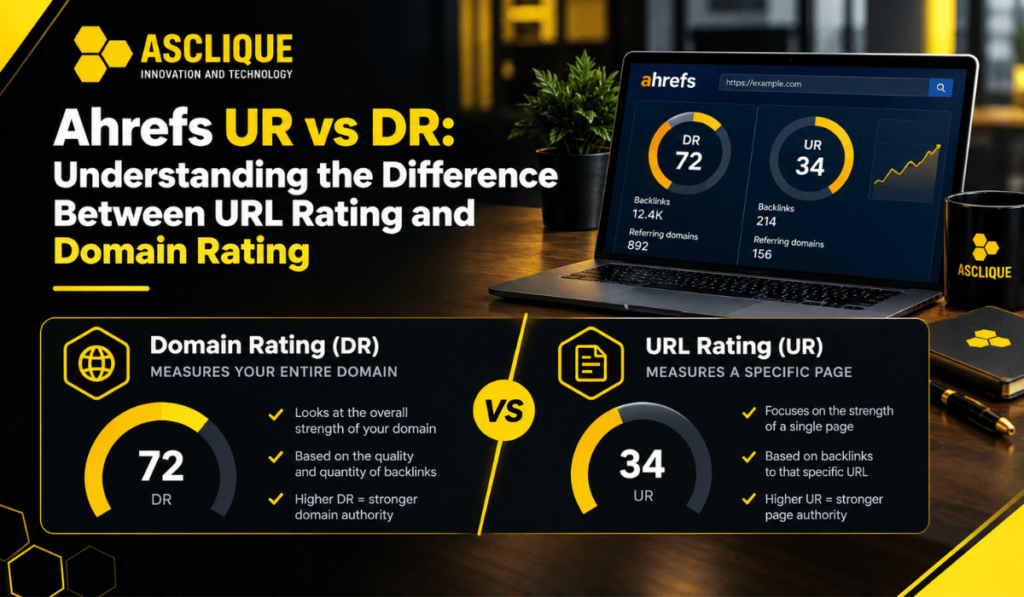
Ahrefs provides two closely related but distinct metrics: Domain Rating (DR) and URL Rating (UR). Both measure backlink strength, but they measure it at different levels — one for the entire website, one for an individual page. Understanding the difference helps you use these metrics correctly in competitive analysis and link building decisions.
What Is Domain Rating (DR)?
Domain Rating measures the overall backlink strength of an entire website’s domain. It is calculated on a logarithmic scale from 0 to 100. A higher DR means the domain as a whole has a stronger, broader backlink profile — more referring domains, more links from high-authority sites.
DR looks at the complete picture of who links to any page on the domain and how authoritative those linking sites are.
When to use DR:
- Evaluating whether a website is a strong link prospect
- Comparing your domain’s overall backlink strength against competitors
- Tracking the long-term growth of a domain’s authority through link building efforts
- Vetting publisher sites for guest posting or niche edit outreach
What Is URL Rating (UR)?
URL Rating measures the backlink strength of a specific individual page, rather than the domain it sits on. It uses the same 0–100 logarithmic scale as DR and is calculated using a similar methodology, but applied only to links pointing to that exact URL.
A page’s UR reflects how many links it has attracted, and how authoritative those linking pages are themselves.
When to use UR:
- Evaluating whether a specific page is likely to rank in competitive SERPs
- Identifying which pages on your own site have the strongest link equity to distribute through internal links
- Determining which competitor pages are well-supported by backlinks versus which rely primarily on domain authority
- Prioritizing which pages to build links to as part of a targeted link campaign
Why a Page’s UR Can Be Higher Than the Site’s DR
This is a frequently confusing situation. Ahrefs confirms in its own documentation that a page’s UR can legitimately exceed the domain’s DR — and this is not an error.
It happens when a single page has attracted a large number of links from high-authority sites, even if the rest of the domain has very few links. For example, a small business website might have a DR of 25, but one viral post or heavily-cited resource on that site might have a UR of 60 because it has been linked to by dozens of authoritative publications.
The key point: DR reflects the domain’s aggregate link profile, while UR reflects the accumulated link equity of a specific page. These do not have to align.
DR vs. UR: Key Differences at a Glance
| Domain Rating (DR) | URL Rating (UR) | |
|---|---|---|
| What it measures | Entire domain’s backlink strength | A single page’s backlink strength |
| Scale | 0 to 100 (logarithmic) | 0 to 100 (logarithmic) |
| Influenced by | All links to any page on the domain | Only links pointing to that specific URL |
| Can UR > DR? | N/A | Yes — this is expected and common |
| Primary use case | Domain-level competitive analysis | Page-level ranking potential and link equity |
| Updated by | Ahrefs crawler | Ahrefs crawler |
How Internal Links Affect URL Rating
Internal links pass link equity between pages on your own site. A page with a high UR can transfer some of that equity to other pages through internal links — this is one of the key mechanisms for strategic internal linking in SEO.
If your home page has a UR of 50 and you add an internal link to a new product page, that product page benefits from some of the home page’s link equity. This is why auditing internal link structure matters: pages that could rank well may be underperforming because no high-UR pages are linking to them.
Practical use: run a UR report on your highest-traffic pages and confirm they are internally linking to the pages most important to your business. If not, adding those links is a quick, high-value optimization.
How to Use DR and UR Together
DR and UR provide different information and are most useful in combination:
When evaluating a link prospect: Check the DR of the domain first to gauge overall site authority. Then check the UR of the specific page where your link would be placed. A link from a page with UR 40 on a DR 45 domain is stronger than a link from a page with UR 5 on the same domain.
When analyzing competitor rankings: Check the DR of competing domains to understand relative domain authority. Then check the UR of the specific competing page to understand how strongly that particular page is backed by links. A competitor ranking with a high UR and low DR is often vulnerable — they are relying on a well-linked page rather than overall domain strength.
When prioritizing internal links: Identify your highest-UR pages and ensure they link to your most important commercial or product pages. This concentrates link equity where it matters most.
Frequently Asked Questions
What is the difference between DR and DA?
DR is an Ahrefs metric; DA (Domain Authority) is a Moz metric. Both measure domain-level backlink strength, but they use different indexes and calculations. The scores for the same domain often differ significantly.
Is DR or UR more important for ranking?
Neither is directly a Google ranking factor — both are third-party approximations. For ranking potential, UR is arguably more relevant because it reflects the link equity of the specific page that needs to rank, not the domain as a whole. In practice, both matter.
Why did my DR drop overnight?
DR changes when Ahrefs updates its link index or recalibrates its algorithm. It can also drop if sites that were linking to you lose their own DR, or if Ahrefs removes low-quality links from its index. Minor fluctuations are normal and not cause for concern.
Can I improve UR without building external links?
Yes — adding internal links from high-UR pages on your own site to a target page is the most direct way to improve that page’s UR without requiring new external links.
How do I check UR and DR for any website?
Both metrics are available in Ahrefs’ paid plans under Site Explorer. DR can also be checked for free using Ahrefs’ website authority checker at ahrefs.com/website-authority-checker.
Understanding DR and UR is foundational to using Ahrefs effectively for competitive research and link strategy. Asclique’s link building services target high-quality placements that move both page-level UR and domain-level DR over time. Our SEO services include regular backlink profile audits to ensure link equity is working in the right direction.