
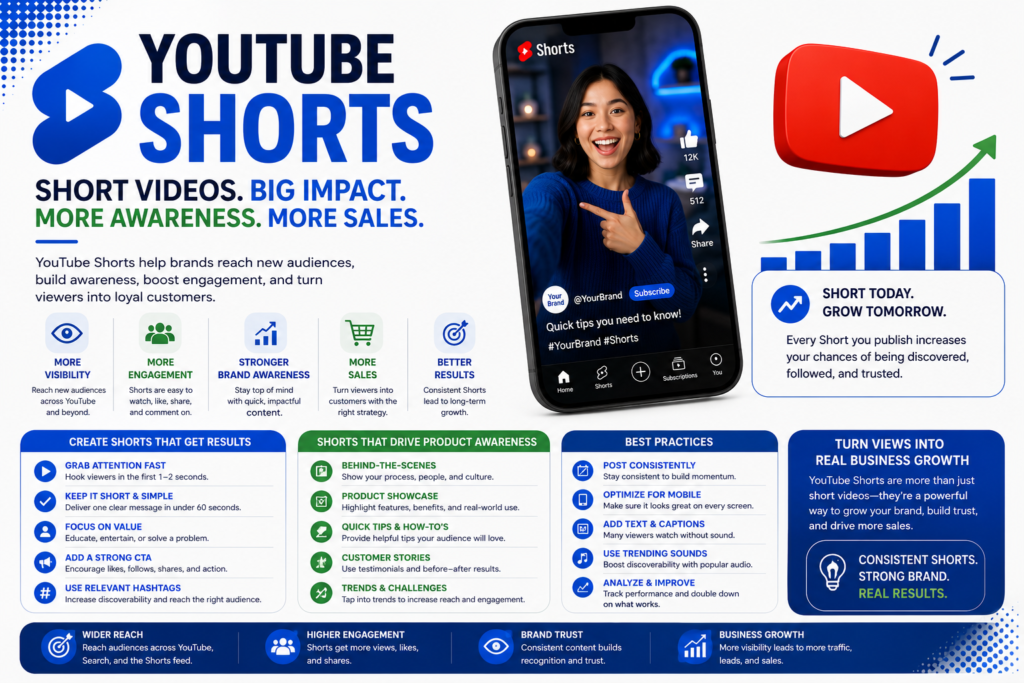
Short-form video has completely rewritten the rules of discovery. What once required a prime-time television slot or a five-figure ad campaign to accomplish – reaching thousands of unfamiliar eyes in a matter of seconds – now happens in under a minute on a phone screen. YouTube Shorts, Google’s vertical video format embedded directly into the world’s second-largest search engine, has quietly become one of the most powerful and underused channels in a brand’s marketing playbook.
The difference between brands earning real traction on Shorts and those that post into the void isn’t budget – it’s strategy. The brands finding success here are asking sharper questions before they even hit record. They’re not just posting more; they’re thinking about why a specific viewer would stop scrolling, watch to the end, and remember who made the video. Part of that process often begins with understanding what drives distribution on the platform – questions like how to get views on shorts tend to surface early in the strategy conversation, but visibility is only the opening chapter of a much longer story for brands serious about awareness.
Why the Shorts Algorithm Is a Genuine Equalizer for Brands
The greatest lesson that can be learned by any marketing team about YouTube Shorts is that it is much more about the content than it is about the number of followers. The short feed recommendation algorithm focuses on watch-through rate, replays, shares, and comments from viewers, more than any other factor, even channel size and popularity. If a brand can maintain interest from the first frame to the last second of a video, it can reach 400 subscribers to half a million people in 48 hours.
This is good news for small businesses, eCommerce ventures and independent content creators who have always been intimidated by competitors with bigger media budgets. The algorithm doesn’t register your ad spend. It reacts only to the activities of its users and if viewers pay attention to your content, it will be shared with more of the right audience. Each video is, in essence, a new one for discovery, irrespective of your channel’s past.
Building a Brand Identity That Viewers Actually Remember
This is precisely where many brands stumble. They create Shorts content without any cohesive visual or tonal identity, resulting in a channel that looks and feels like it was produced by five different people with no shared creative direction. Awareness doesn’t materialize from a single viral hit; it accumulates through the consistent repetition of recognizable elements. That might mean a specific color palette, a familiar on-screen host, a recurring format, or a distinctive editing style – something viewers begin to associate with your brand before they even see your logo.
The brands making meaningful gains on Shorts in 2026 have largely stopped chasing every trending audio clip or meme format and started investing in distinctiveness instead. Trend participation can generate short bursts of traffic, but it rarely builds the durable recognition that makes someone think of your brand weeks later when they actually need what you sell. Consistency of format and voice is what creates that mental footprint, and it doesn’t demand expensive production. Many of the highest-performing brand Shorts are filmed in natural light on a smartphone, because the content itself is intentional, focused, and built with purpose.
Showcasing Products Without Triggering the Skip Response
This is arguably the most critical skill for any brand to develop specifically for Shorts: demonstrating a product in a way that feels native to the format rather than borrowed from a television commercial. The platform’s short-form audience has a remarkably well-calibrated instinct for anything that resembles a sales pitch, and they’ll swipe away within the first two seconds if something triggers that instinct – even faintly.
Lead With the Problem, Not the Product
The creative approach that consistently outperforms direct promotion is problem-first storytelling. Don’t open on your product. Open on a moment, a frustration, or a scenario the viewer immediately recognizes from their own experience. A kitchen brand doesn’t launch with “Introducing our new knife set.” It opens on the specific pain point – the struggle, the mess, the failure, and the product arrives as the natural resolution. By the time it’s in frame, it reads like a solution rather than an advertisement. The sale isn’t the point of the video; the story is.
Turn Viewer Interest Into Sales
YouTube’s native Shopping features make this framework significantly more potent. Brands can tag products directly inside Shorts, creating a near-frictionless path from a moment of curiosity to a completed checkout. But the tag only does its job when the content preceding it has built genuine desire. A shoppable link sitting inside a forgettable video is functionally invisible. The same link in a video someone watched twice and forwarded to a friend is a different situation entirely. That’s where passive awareness converts into measurable action.
Consistency Is the Long Game, and It’s the Only One Worth Playing
Brands tend to approach Shorts in bursts. Intense, high-frequency posting for a few weeks, followed by silence when immediate results don’t appear. This pattern is one of the most common and quietly destructive mistakes in short-form content strategy. The algorithm consistently favors channels that publish with regularity, and the audience – even if they don’t consciously register it – responds more favorably to brands that feel like active, ongoing presences rather than sporadic ones.
Integrate Shorts Into Your Overall YouTube Marketing Strategy
While YouTube Shorts are excellent for increasing brand awareness and attracting new viewers, they deliver the best results when they’re part of a broader YouTube marketing strategy. Combining Shorts with long-form videos, YouTube SEO, playlists, channel optimization, and consistent publishing helps brands build authority, grow subscribers, and generate long-term business results.
If you’re looking to create a complete YouTube strategy, read our YouTube Marketing: A Complete Guide for Your Brand in 2025.
Every Short Builds Long-Term Visibility
Every Short published adds to a brand’s position in YouTube’s recommendation pool. Videos uploaded six months ago continue generating views and introducing unfamiliar viewers to a brand long after the posting date, compounding awareness over time without any additional input or spend. This is the compounding effect that makes short-form video so uniquely valuable as a long-term marketing channel. It’s one of the few formats where past work appreciates rather than simply aging out of relevance.
Conclusion
Brands achieving real product awareness through YouTube Shorts are not the ones gambling on a single viral moment. They’re the ones building something deliberate, showing up week after week with content that’s honest, specific, and genuinely made for the people they’re trying to reach, not just content that performs the appearance of effort.
FAQ’s
What are YouTube Shorts?
YouTube Shorts are vertical videos of up to three minutes designed for quick, mobile-first viewing. They help brands reach new audiences through YouTube’s recommendation system.
How can YouTube Shorts increase brand awareness?
Shorts expose your content to viewers beyond your subscriber base. Engaging videos can be recommended to thousands of new users, helping brands build recognition organically.
Do I need a large subscriber base to get views on YouTube Shorts?
No. The Shorts algorithm prioritizes viewer engagement metrics such as watch time, completion rate, replays, shares, and comments rather than subscriber count.
How often should brands post YouTube Shorts?
Consistency is more important than volume. Posting two to five quality Shorts per week is generally more effective than publishing many videos inconsistently.
What makes a successful YouTube Short?
Strong hooks, clear storytelling, high viewer retention, authentic content, and a recognizable brand style are some of the biggest factors behind successful Shorts.
Should brands follow every trending sound or challenge?
Not necessarily. Trends can boost short-term visibility, but maintaining a consistent brand voice and identity is more effective for long-term awareness.
How can I promote products without making my Shorts feel like ads?
Start by highlighting a problem or relatable situation before introducing your product as the solution. Educational, entertaining, or behind-the-scenes content typically performs better than direct sales pitches.
Can YouTube Shorts drive sales as well as awareness?
Yes. When combined with YouTube Shopping features, Shorts can help viewers discover products and purchase them directly from the video.
How long does it take to see results from YouTube Shorts?
Results vary by niche and content quality. Some videos gain traction within days, while consistent posting over several months often produces stronger long-term growth.
Do older YouTube Shorts continue getting views?
Yes. Unlike many social platforms, YouTube Shorts can continue appearing in recommendations weeks or even months after publication, generating ongoing exposure.
What metrics should brands track for YouTube Shorts?
Key performance indicators include views, watch time, average view duration, completion rate, audience retention, likes, comments, shares, subscribers gained, and click-throughs to products or websites.
Is YouTube Shorts suitable for small businesses?
Absolutely. Because the algorithm focuses on content quality and viewer engagement rather than budget, small businesses have a strong opportunity to compete with larger brands.