
The digital marketing landscape has undergone a massive transformation. Google’s AI Overviews, People Also Ask features, and AI search engines now heavily favor FAQ (Frequently Asked Questions) content. If you’re a business owner or content creator, understanding how to create FAQ content that boosts AI visibility is no longer optional—it’s essential.
According to Semrush’s research, over 80% of AI Overview queries are informational in nature, and more than 80% have average monthly search volumes under 1,000. This means long-tail queries and conversational language are now critical to your SEO strategy.
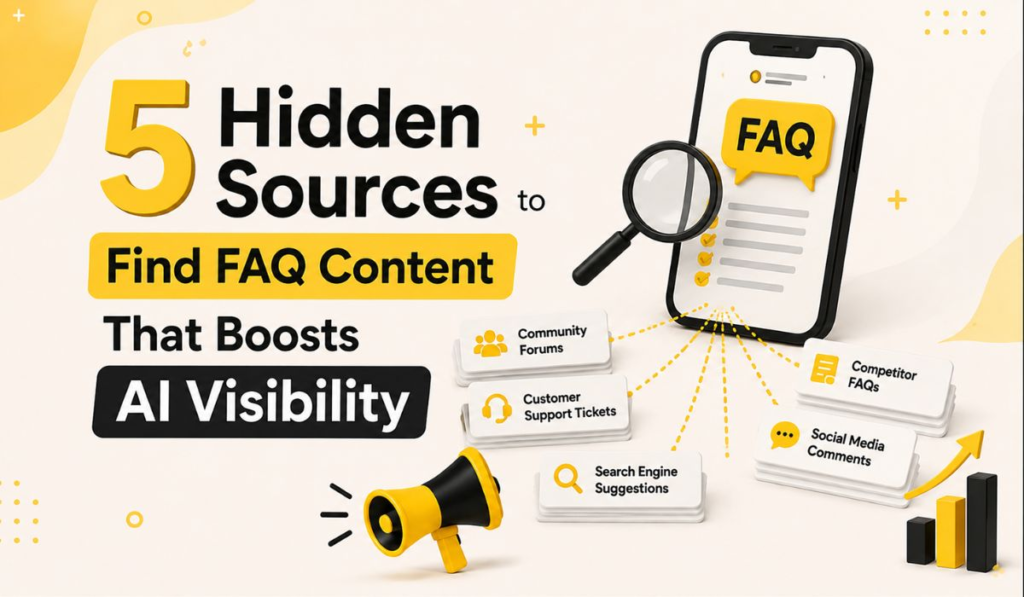
Let’s explore the 5 best sources where you can find exceptional FAQ content ideas:
1. Google Search Console (GSC) Data – Your Hidden Treasure
Every SEO professional knows about Google Search Console, but most people aren’t using it strategically for FAQ research. This is a massive missed opportunity.
How to Use It Effectively
First, you need to filter for question-based queries. Use this regex pattern:
^(who|what|where|when|why|how|which|whose|whom|is|are|was|were|do|does|did|can|could|will|would|should|has|have|had)\bThis regex will filter all queries that start with question words—exactly what you need for FAQ content.
Finding the Sweet Spot
Here’s the strategic approach:
- Positions 1-3: Your content is already performing well—don’t disrupt it
- Positions 4-20: This is your golden opportunity for dedicated FAQ content
- Page 2-3: Your content lacks relevance—a major red flag
Practical Example: If your query “how to choose the best SEO tools” ranks at position 7 but has low CTR, that’s a clear signal that users aren’t finding the answer they need. This is where a dedicated FAQ section makes a difference.
Don’t Forget Long-Tail Queries
Use this regex to find queries with 8+ words:
^(\S+\s+){8,}\S+$This technique reveals surprisingly effective hidden opportunities that most competitors miss.
2. People Also Ask (PAA) – Google’s Golden Signal
The People Also Ask feature is Google’s way of showing you directly which related questions users are asking and how topics connect to each other.
What You Get From PAA
- Related Questions: Topics connected to your main search query
- Search Intent Relationships: Clear patterns in user behavior
- Topical Clusters: Networks of related topics and questions
- Content Gap Opportunities: Questions your competitors haven’t answered
Step-by-Step Research Process
- Search your target keywords on Google
- Expand the “People Also Ask” section completely
- Repeat for 5-10 priority terms in your niche
- Document recurring questions—these are high-signal FAQ opportunities
Recommended Tools
- AnswerThePublic – Visualizes all questions in a beautiful format
- AlsoAsked – Creates detailed question trees and hierarchies
- Exploding Topics – Shows trending topics before they peak
Pro Tip: Use Exploding Topics to create content before demand spikes. When users start searching for something, your content will already be ranking!
3. Customer Insights and Internal Data – Your Goldmine
This is the most powerful source, yet most businesses overlook it completely. Your customer service team hears real questions from real people every single day—this is invaluable data.
What Data Should You Collect?
A) Customer Service Data:
- Which questions appear most frequently in support tickets?
- What confusion patterns do you see in customer emails?
- What pain points do customers mention in phone calls?
- What objections keep coming up?
B) Site Search Data:
- If your website has a search function, queries typed into it reveal content gaps
- Long-tail and question-based queries are particularly valuable
- Users wouldn’t search if they found the information easily
C) Sales Call Data:
- What objections do prospects raise repeatedly?
- Which topics cause the most hesitation?
- What features or services confuse customers?
Easy Implementation Framework
📋 Simple Data Collection System:

1. Google Doc - Dedicated space for customer service team
2. Slack Channel - Daily questions posted in real-time
3. Monthly Review - Analyze trends and patterns
4. AI Analysis - Use Claude or ChatGPT to identify themes
Real-World Example: If your calls are recorded and your AI policy allows it, ask Claude or ChatGPT: “What are the top 10 recurring questions in these transcripts?” Instant, actionable insights.
4. Reddit – The Voice of Authentic Users
Reddit is gold because people ask naturally, without worrying about keyword optimization. You get real language, real questions, real hesitations—exactly what AI models are trained to understand.
How to Get Started
- Find your niche subreddit using RedditAnswers
- Search for your target keywords within those communities
- Sort by “Best,” “Top,” and “New” for different perspectives
- Pay attention to follow-up questions—these are FAQ gold
What Makes Reddit Unique
Reddit threads contain secondary questions that traditional keyword tools completely miss. When someone provides an initial answer, other users ask follow-ups like “OK, but what about…?” These layered questions reveal the true depth of user curiosity.
Real Example:
- Main Question: “Best SEO tools for small business?”
- Follow-up Questions:
- “Are there free options?”
- “Which has the easiest learning curve?”
- “How’s the customer support?”
- “Can it handle multiple websites?”
Addressing these secondary questions in your FAQ content significantly improves topical depth and the authority signals that AI models favor.
5. AI Prompt Volume – Data From the Future
This is the newest source, and it’s revealing how user behavior is shifting. When people ask questions on ChatGPT, Claude, or Google Gemini, that data tells you what’s really on their minds.
Tools Worth Monitoring
- Writesonic – Tracks AI visibility and prompt trends
- Profound – Aggregates AI search insights
- ChatGPT Trends – Monitor what people are asking AI assistants
Why This Matters
AI searches are fundamentally different from Google searches:
- Longer and more detailed than traditional queries
- More specific and niche-focused
- Conversational in tone with full context
- Emerging earlier than they appear in Google searches
This data essentially gives you a crystal ball to see what FAQ topics will become important before your competitors notice.
How to Implement a Complete FAQ Strategy
The Combined Research Framework
🎯 Complete FAQ Research Methodology:

1. GSC + PAA = Technical keyword research foundation
2. Customer Data = Real user needs and pain points
3. Reddit = Authentic voice and natural language
4. AI Prompts = Emerging trends ahead of curve
5. Site Search = Content gap identification
How to Organize Your Findings
- Primary FAQs: High search volume + major customer pain points
- Secondary FAQs: Related questions from People Also Ask
- Specific FAQs: Product or service-specific inquiries
- Emerging FAQs: Trends emerging in AI prompt volumes
Why FAQ Content Requires Ongoing Maintenance
Creating FAQ content isn’t a one-time project—it’s an ongoing process.
When Should You Update FAQs?
- After product launches = New specifications and features
- Following competitor moves = Market changes
- Seasonal trends = Time-based questions change
- Regulatory updates = Compliance and legal changes
- Customer feedback = New objections and concerns
Update Frequency by Industry
- Technology/SaaS: Frequent updates (monthly or quarterly)
- Service-based: Regular updates (quarterly or bi-annually)
- Traditional trades: As-needed updates
- News-related: Real-time updates
The Bottom Line
FAQ content has become the backbone of modern digital marketing. Whether you’re optimizing for Google AI Overviews, aiming for traditional organic search rankings, or trying to appear in AI chatbot responses, FAQ strategy is non-negotiable.
Key Takeaways:Use Google Search Console to find question-based queries your competitors are missing
Leverage People Also Ask to understand topic relationships and topical clusters
Mine customer data from support tickets, sales calls, and internal search
Study Reddit discussions to see authentic user language and follow-up questions
Monitor AI prompt volumes to stay ahead of emerging trends
Keep your FAQ content fresh and updated as your business evolves
Take Action Today
Don’t just read this guide—implement it immediately.
This week:
- Open your Google Search Console
- Filter for question-based queries using the regex provided
- Identify 5 queries ranked in positions 4-20 with low CTR
- Research related questions using People Also Ask
- Start drafting FAQ content around these topics
Next week:
- Review your customer support tickets
- Interview your customer service team
- Analyze your internal site search data
- Create a prioritized list of FAQ topics
- Begin writing comprehensive FAQ content
The brands winning search visibility aren’t the ones that created FAQ content once and forgot about it. They’re the ones continuously answering new questions as customer needs evolve, as competitors move, and as the search landscape shifts.
Remember: In SEO, FAQ content isn’t just about ranking—it’s about building trust, authority, and long-term visibility in an AI-driven search environment.
Ready to dominate AI search results? Start with better questions—the answers will follow. ✨