
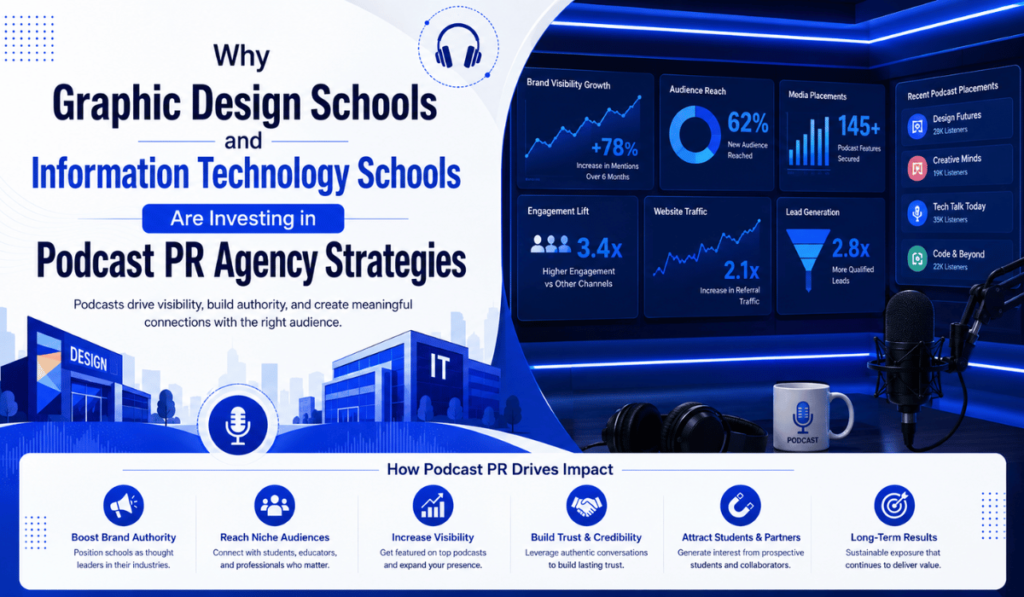
Graphic design schools are no longer focused solely on classroom instruction, as many are now exploring new ways to reach prospective students where they already spend their time; podcasts have quickly become one of the most effective channels.
Students researching creative or technical careers rarely rely on brochures alone anymore, as they compare schools through YouTube videos, social media, alumni interviews, and long-form conversations that reveal what a program is actually like.
For anyone researching Graphic Design Schools, hearing authentic discussions about career preparation, portfolio development, and industry trends often provides more confidence than reading a traditional admissions page.
Podcast appearances allow educators, graduates, and industry professionals to explain complex topics in a relaxed format, making schools feel more approachable while building credibility with future students.
Why podcasts are becoming a trusted source for education decisions
Choosing a college has become a research-heavy process because students want to understand what happens after graduation rather than simply reviewing course descriptions.
Someone interested in branding, motion graphics, or user experience design wants answers to practical questions like whether graduates build strong portfolios, how instructors teach creative thinking, and what kinds of careers are available.
A podcast interview naturally creates space for those discussions without feeling like a sales presentation.
Instead of hearing a scripted marketing message, listeners hear conversations about classroom projects, internships, creative challenges, and changing industry expectations.
That authenticity matters because today’s students often trust educational content that teaches first and promotes second, which is why many institutions are partnering with a Podcast PR Agency to share valuable insights through credible, long-form conversations instead of relying solely on traditional advertising.
The growing connection between creative education and technology
Graphic design and information technology may seem like separate disciplines at first glance, but modern workplaces increasingly expect professionals to understand both creative communication and digital tools.
A designer working on a mobile application, for example, frequently collaborates with software developers, UX researchers, cybersecurity specialists, and digital marketers throughout a single project.
Likewise, IT professionals benefit from understanding visual communication when building user-friendly websites, dashboards, or business applications.
Because of this overlap, educational institutions are highlighting interdisciplinary learning more than ever before.
Podcast interviews provide an ideal platform to explain how these skills complement each other through real-world examples instead of abstract course descriptions.
How podcast PR agencies strengthen school visibility
Creating a podcast is one strategy, but appearing on established shows often delivers faster exposure to highly targeted audiences.
Podcast PR agencies identify programs whose expertise matches relevant podcasts before coordinating interviews with hosts who already have engaged listeners.
For example, an admissions leader discussing portfolio preparation on a creative careers podcast reaches students actively researching design education rather than broadcasting to a broad audience with limited interest.
An information technology instructor explaining artificial intelligence, cybersecurity, or cloud computing can similarly reach listeners considering future-proof career paths.
This targeted approach often produces stronger engagement because the audience has already demonstrated interest in the topic.
Building trust through meaningful conversations
Trust has become one of the biggest factors influencing enrollment decisions.
Students can easily compare tuition costs and program outlines online, but understanding the learning experience is much harder.
A podcast gives faculty members an opportunity to explain how they mentor students through difficult projects, encourage creative problem-solving, and prepare graduates for changing industry demands.
Imagine a prospective student commuting to work while listening to an hour-long discussion about branding trends or digital illustration.
That conversation creates a far deeper connection than a thirty-second advertisement because it answers questions the student did not even know to ask.
Long-form discussions also allow alumni to share realistic career journeys, including early challenges, portfolio revisions, internship experiences, and professional growth.
Those stories make educational pathways feel achievable rather than intimidating.
Information technology schools are following the same strategy
Technology education faces similar challenges when attracting students.
Fields such as cybersecurity, software development, artificial intelligence, and network administration evolve rapidly, making it difficult for websites alone to communicate current industry expectations.
Podcast interviews allow instructors and industry partners to discuss emerging technologies in language that prospective students can actually understand.
Instead of listing technical certifications, they can explain how those credentials solve real business problems or improve career opportunities.
That educational approach naturally builds authority while helping listeners make informed decisions.
Reaching audiences beyond traditional marketing
Traditional advertising still has value, but audience behavior has changed significantly.
Many students spend their time consuming educational podcasts while driving, exercising, or working.
This creates repeated opportunities for schools to become familiar voices rather than unfamiliar advertisements.
A single podcast episode may continue attracting listeners months or even years after publication.
Unlike a short-lived social media campaign, evergreen interviews remain searchable across multiple podcast platforms.
That extended lifespan gives institutions long-term visibility without requiring constant promotional spending.
What students gain from educational podcasts
Podcast content benefits prospective students just as much as educational institutions.
Instead of relying entirely on rankings or promotional materials, listeners gain practical insights directly from faculty members, industry professionals, graduates, and employers.
They learn what portfolio reviews actually involve.
They discover which technical and creative skills employers consistently value.
They hear honest discussions about workload, collaboration, internships, and career preparation.
These details help students compare programs based on substance rather than marketing language.
As a result, applicants often make more confident enrollment decisions because they better understand what to expect.
The future of higher education marketing
Education marketing continues shifting toward authenticity, expertise, and valuable conversations.
Students increasingly expect institutions to educate before attempting to recruit.
Podcast PR strategies align perfectly with that expectation by allowing schools to demonstrate knowledge instead of simply claiming it.
Whether discussing visual storytelling, digital illustration, software engineering, user experience, or emerging technology, meaningful conversations create stronger connections than traditional advertising alone.
As competition for student attention continues growing, institutions that consistently share useful insights across trusted podcast platforms will likely remain more visible, more credible, and more memorable throughout the decision-making process.