
Quick Answer
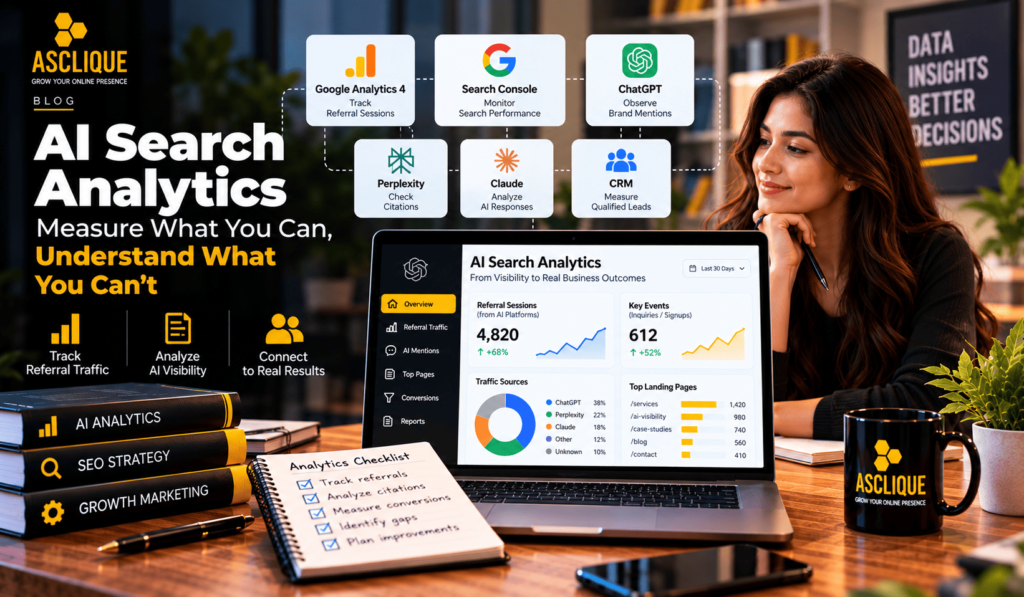
Build an evidence-based measurement plan using identifiable referral sessions, key events, CRM outcomes, controlled prompt observations, and annotated limitations. The result is a dashboard that describes what happened rather than claiming to measure every AI answer.
Key Facts
- GA4 can classify sessions using available source, medium, and campaign information; it does not count all off-site AI mentions.
- Search Console performance data concerns Google Search and does not provide a complete cross-assistant visibility report.
- A user can see a brand in an AI answer without clicking its website.
- Referrer data can be absent or altered, so unattributed traffic is not automatically AI traffic.
- GA4 key events can measure selected actions after a visit when implemented correctly.
Verified reference points: Google Search Central; Google Analytics Help; Search Console URL Inspection.
Table of Contents
- What Is AI Search Analytics?
- Why AI Search Analytics Matters
- How AI Search Analytics Works – Step by Step
- Tools You Should Use
- Common Errors and How to Fix Them
- Weak Approach vs Better Approach
- Common Mistakes to Avoid
- What Is Not Proven
- How to Measure Success
- Checklist
- Frequently Asked Questions
- Asclique Recommendation
- Need Help With This?
What Is AI Search Analytics?
AI search analytics is the practice of combining web analytics, business outcomes, and structured observations to evaluate traffic and exposure associated with AI-powered discovery. Its components have different units: sessions, users, leads, cited URLs, and brand mentions.
For example, a B2B software firm might see visits from an identifiable assistant domain, but the tool cannot tell how many people read an answer and chose not to click. A separate prompt sample can document citations without turning them into traffic.
A trustworthy report labels each source, explains what it captures, and avoids adding incompatible figures together.
Why AI Search Analytics Matters
AI discovery can influence a buyer before a website visit occurs. If marketing teams look only at organic search clicks, they may miss evidence of emerging referral sources or changes in how prospects describe their research.
The reverse risk is equally important: teams can exaggerate AI performance by treating all direct traffic as assistant-generated. That makes budget decisions depend on assumptions rather than records.
An effective AI search measurement strategy works alongside traditional SEO services to help businesses understand their organic visibility, referral traffic, and search performance.
A measurement framework allows owners to see which observations are reliable, where instrumentation is incomplete, and which customer outcomes justify further investment.
AI search is becoming another important part of digital discovery. Businesses looking to improve online visibility should consider traditional search performance alongside emerging AI-powered discovery channels.
Strengthen Your Ai Search Analytics FoundationReview the specific technical and content decisions that affect this topic, with documented evidence. | Explore SEO Services |
How AI Search Analytics Works – Step by Step
Step 1: Inventory the questions prospects ask and list which outcomes can be observed
Inventory the questions prospects ask and list which outcomes can be observed. Separate off-site mentions, attributable sessions, and qualified opportunities before designing a chart.
Step 2: Audit GA4 acquisition dimensions, consent behavior, referral exclusions, and key event setup
Audit GA4 acquisition dimensions, consent behavior, referral exclusions, and key event setup. Test with a known visit where possible; an empty source report can reflect instrumentation rather than no demand.
Step 3: Create an exploratory report using session source/medium and landing page
Create an exploratory report using session source/medium and landing page. Search for identifiable assistant referrals while retaining original source strings; do not rewrite unknown sessions as AI.
Step 4: Inspect Search Console for Google Search clicks and impressions on relevant pages
Inspect Search Console for Google Search clicks and impressions on relevant pages. Label these as search data, not cross-platform AI citations.
Step 5: Create a small controlled prompt panel for brand and citation observations
Create a small controlled prompt panel for brand and citation observations. Save exact wording, test dates, assistants, and response evidence, then keep this panel separate from GA4.
Step 6: Connect inquiries to CRM records with available source information
Connect inquiries to CRM records with available source information. Review lead quality, closed opportunities, and time lag rather than declaring success from session counts alone.
Step 7: Annotate tracking changes, campaigns, site releases, and assistant changes
Annotate tracking changes, campaigns, site releases, and assistant changes. Reconcile month-to-month comparisons only after confirming that measurement definitions stayed consistent.
Tools You Should Use
GA4 Traffic acquisition
Review session source/medium and attributable visits; compare landing pages without assuming every visit reveals its origin.
Use this tool only for the information it actually provides. Preserve the original export, tested URL, or report settings so the result can be checked after a website or platform update.
Beyond GA4 and Google Search Console, businesses can explore dedicated AI visibility tools to monitor brand mentions, citations, and visibility across AI-powered search platforms.
GA4 Explorations
Create filtered reports for known referral sources and inspect key events by landing page.
Use this tool only for the information it actually provides. Preserve the original export, tested URL, or report settings so the result can be checked after a website or platform update.
Google Search Console
Check search clicks, impressions, and page indexing; keep Google Search metrics distinct from assistant exposure.
Use this tool only for the information it actually provides. Preserve the original export, tested URL, or report settings so the result can be checked after a website or platform update.
CRM and lead forms
Compare attributable inquiries with sales-qualified opportunities and revenue when data is available.
Use this tool only for the information it actually provides. Preserve the original export, tested URL, or report settings so the result can be checked after a website or platform update.
Controlled response log
Record brand mentions and cited URLs from repeatable prompts, with dates and test conditions.
Use this tool only for the information it actually provides. Preserve the original export, tested URL, or report settings so the result can be checked after a website or platform update.
Common Errors and How to Fix Them
The following issues have different causes and require different corrective actions. Diagnose the source before changing website content or analytics settings.
Weak Approach vs Better Approach
A better process makes its assumptions visible, preserves evidence, and connects the finding to a clear next action.
Common Mistakes to Avoid
Assuming: Assuming referral headers always survive redirects and privacy settings. Identify the specific page, report, or decision affected before treating this as a priority.
Counting: Counting a page citation as a visit or a visit as a recommendation. Identify the specific page, report, or decision affected before treating this as a priority.
Changing: Changing the prompt panel while comparing monthly mention rates. Identify the specific page, report, or decision affected before treating this as a priority.
Reporting: Reporting raw key events without checking duplicate firing. Identify the specific page, report, or decision affected before treating this as a priority.
Using: Using Search Console as if it measures all assistant platforms. Identify the specific page, report, or decision affected before treating this as a priority.
Review Your Ai Search Analytics GapsGet a focused assessment of current implementation, measurement limits, and practical next steps. | Request an Audit |
What Is Not Proven
No universal AI visibility metric exists across all assistants. A rise in identifiable referrals does not prove that a content edit caused it, and a citation sample does not measure total audience exposure.
At Asclique, we separate documented platform behavior from practitioner observations. Avoid treating an isolated test result as proof of a universal algorithm.
How to Measure Success
Define success in terms of reliable implementation, observable changes, and useful business outcomes. Keep each metric tied to its own source and denominator.
AI search analytics becomes more valuable when connected to business outcomes. Understanding how to generate qualified leads from SEO helps marketers evaluate whether increased visibility contributes to meaningful inquiries and conversions.
Checklist
- Document the specific business objective and owner.
- Identify the priority pages or customer questions.
- Check official documentation for relevant requirements.
- Verify source information and publication dates.
- Review technical access and indexing where applicable.
- Confirm that visible content supports each important claim.
- Record the testing method and its limitations.
- Check for duplicate or conflicting information.
- Test analytics events before using conversion totals.
- Save baseline evidence before making changes.
- Retest after implementation and record the result.
- Schedule a review after material site or platform changes.
FAQ’s
Does GA4 have a complete AI traffic channel?
The answer depends on the scope of AI search analytics and the source you are measuring. Begin with a clearly defined sample or URL set, then document the exact test conditions. Do not infer results for untested pages or platforms.
Can I measure AI impressions across every assistant?
Not automatically. Build an evidence-based measurement plan using identifiable referral sessions, key events, CRM outcomes, controlled prompt observations, and annotated limitations. Record the underlying source and compare it with the visible page or original report before deciding what the result means.
Why do some assistant visits appear as direct traffic?
Use the steps in this guide as a repeatable audit rather than a one-time configuration. Preserve the input, tool settings, date, and output. Recheck after significant changes because an earlier passing test does not verify the current implementation.
Should I combine Search Console and GA4 clicks?
Treat the result as one piece of evidence, not a guarantee. Look for supporting information in the official documentation and in your own measured business outcomes. If the evidence is incomplete, state that limitation rather than filling it with an estimate.
Which conversions matter most?
Choose a metric that directly answers the business question and can be reproduced. Record the numerator, denominator, time window, and data source. Keep observations separate from verified website visits and customer inquiries.
How often should the report be updated?
Assign an owner and revisit the process after major content, technical, or tracking changes. For ongoing programs, a monthly review can reveal recurring problems. The right cadence depends on how frequently the underlying pages and data change.
Asclique Recommendation
Build the dashboard around three questions: what can be observed, what cannot be observed, and which business outcomes changed. Publish source definitions beside the charts so decisions survive staff and platform changes.
Combining AI search analytics with professional content marketing services helps businesses create relevant content, improve search visibility, and measure how content contributes to qualified leads.
Start with the highest-impact pages and a documented baseline. After making changes, retest the same conditions and record what improved, what remained uncertain, and which issue needs a separate investigation.
Need Help With This?
If your team needs help with AI search analytics, Asclique can review the current setup, identify practical corrections, and establish an evidence-based reporting process. The scope should be agreed before changes are made, particularly where analytics or third-party data access is involved.
Asclique digital marketing solutions help businesses connect SEO, content strategy, analytics, and conversion tracking into a measurable marketing approach.
Make Ai Search Analytics ActionableDiscuss a prioritized plan with measurable checks and clear ownership for the next implementation cycle. | Talk to Asclique |